Check Engine Light: What It Means and What to Do
The check engine light means your car's OBD-II system has detected a fault in the engine or emissions controls — but a solid check engine light is not an emergency. CarMD's 2026 Vehicle Health Index reports the average check engine light repair hit $554 in 2025, up 33% from the prior year. The three most common triggers — catalytic converter codes, oxygen sensor failures, and ignition coil problems — are all emissions-related. None require you to pull over. A flashing check engine light is the exception: that signals an active misfire, and you should stop driving immediately.
What the Check Engine Light Means
Every car sold in the United States since 1996 has an OBD-II (On-Board Diagnostics II) system that monitors the engine, transmission, and emissions components through dozens of sensors. When a sensor reading falls outside the manufacturer's programmed threshold, the powertrain control module (PCM) stores a five-character diagnostic trouble code (DTC) and illuminates the check engine light — formally called the Malfunction Indicator Lamp (MIL).
The OBD-II system runs two types of checks. Continuous monitors track misfires, fuel trim, and oxygen sensor signals every time the engine turns on. Non-continuous monitors — catalyst efficiency, EVAP system integrity, secondary air injection — only run under specific driving conditions called a "drive cycle," a mix of highway and city driving. That's why a check engine light sometimes shows up days after a problem starts.
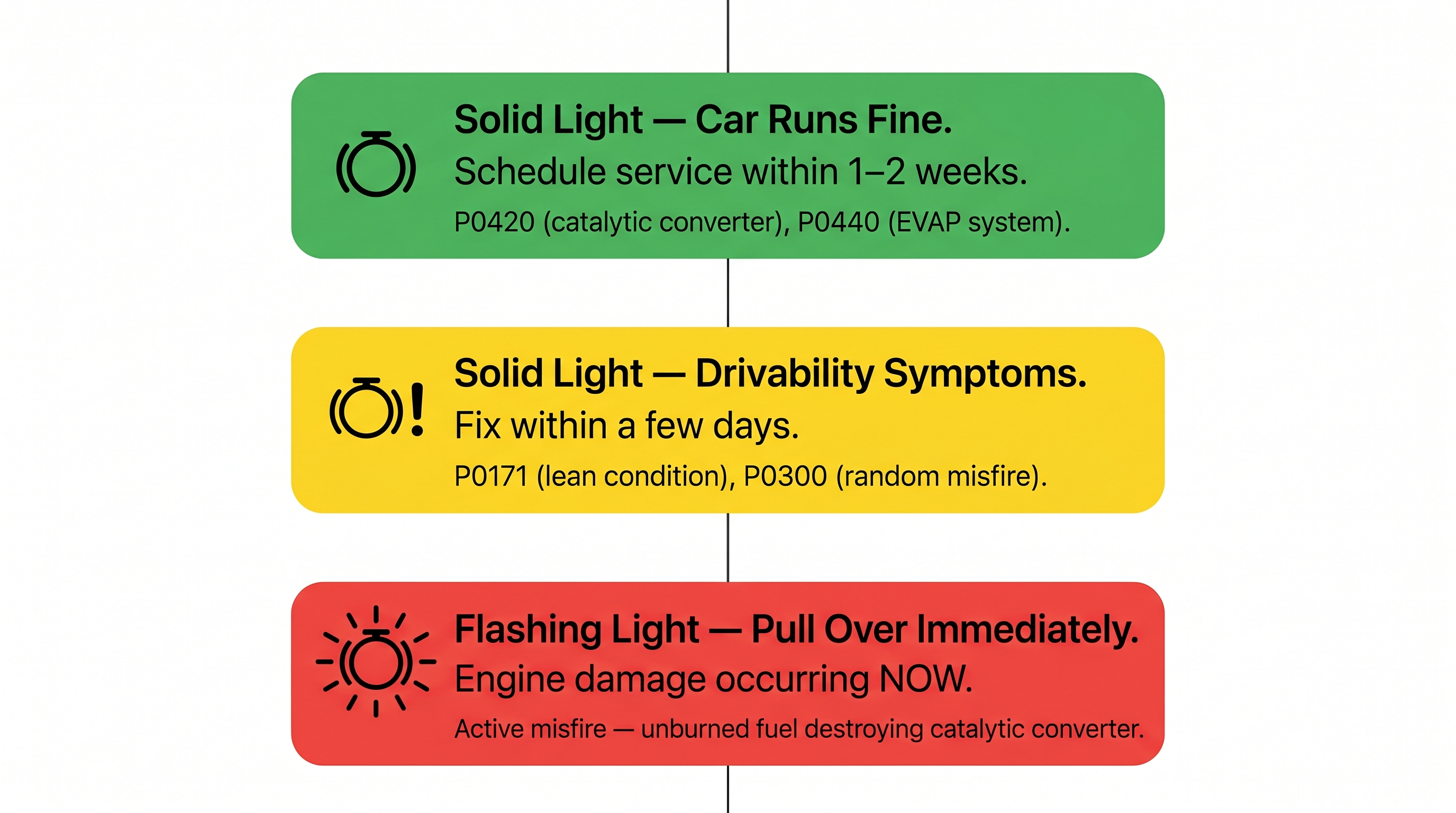
The light itself communicates urgency through one distinction: solid or flashing.
A solid check engine light means the OBD-II system logged a fault that needs attention, but the engine is not at immediate risk of damage. A flashing check engine light means the engine is actively misfiring — unburned fuel is entering the exhaust and can destroy the catalytic converter within minutes. If your check engine light is flashing, pull over and shut off the engine.
Most Common Check Engine Light Codes
The most frequent check engine codes are emissions-related, not mechanical emergencies. CarMD's 2026 Vehicle Health Index found that catalytic converter and oxygen sensor codes account for over 12% of all check engine light repairs, with ignition coil and spark plug failures adding another 9.6%.
| Code | What It Means | What to Do | Typical Repair Cost |
|---|---|---|---|
| P0420 | Catalytic converter efficiency below threshold | Schedule service within 2 weeks | $1,313 average (CarMD) |
| P0171 / P0174 | Fuel system running lean (vacuum leak, dirty MAF sensor) | Fix within 1–2 weeks | $100–$400 |
| P0300 | Random/multiple cylinder misfire | Fix within a few days; urgent if flashing | $150–$400 |
| P0301–P0306 | Specific cylinder misfire (last digit = cylinder number) | Urgent if CEL is flashing | $230–$400 |
| P0440 / P0442 | EVAP system leak | Check gas cap first | $0–$250 |
| P0135 / P0141 | O2 sensor heater circuit malfunction | Schedule service | $434–$537 (RepairPal) |
| P0128 | Coolant temp below thermostat regulating range | Fix within 1–2 weeks | $200–$400 |
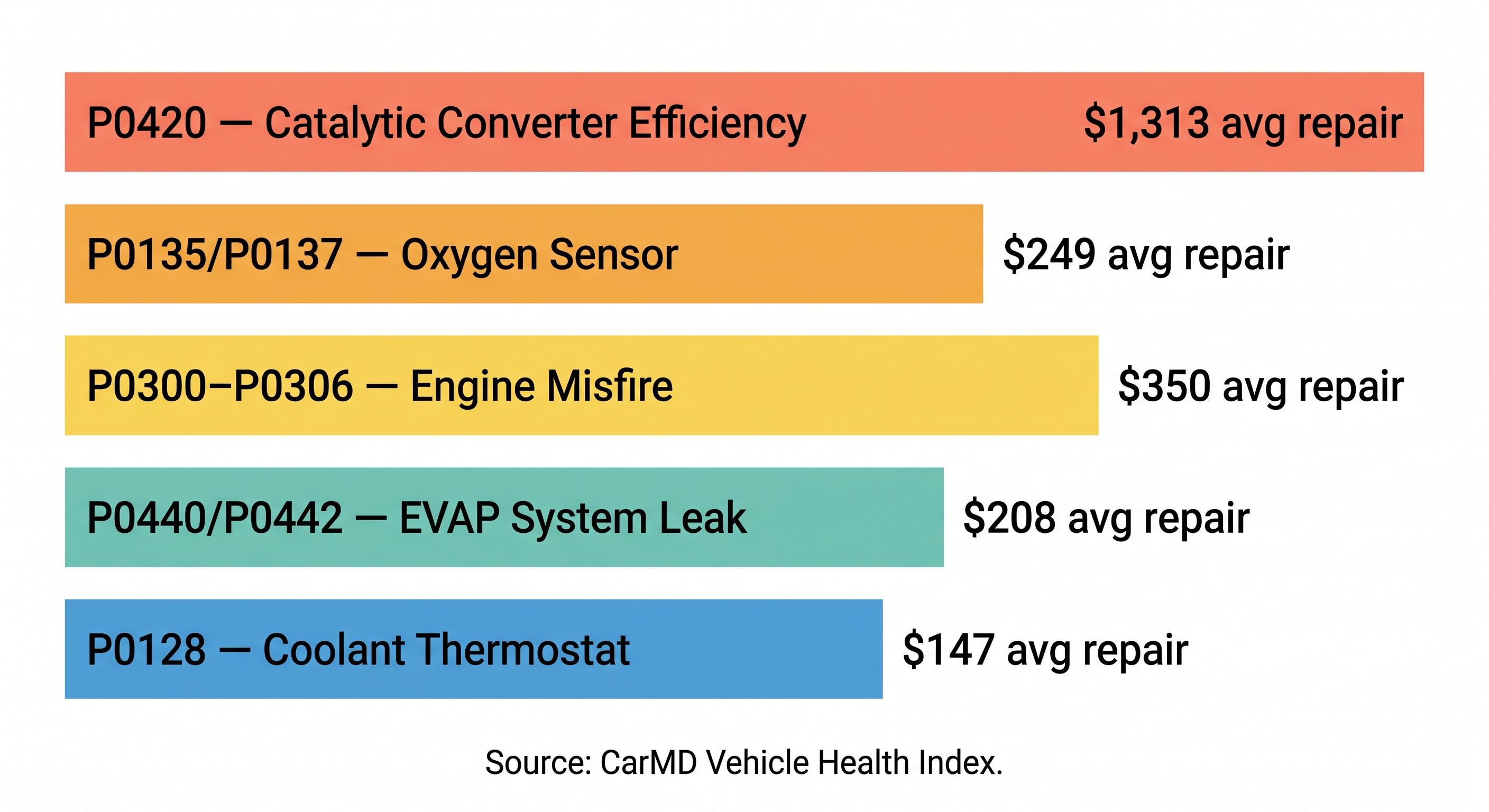
A P0420 doesn't always mean you need a new catalytic converter. A degraded upstream oxygen sensor can produce a false P0420 reading, and misfire codes (P0300–P0306) should always be resolved first — unburned fuel from misfires overheats catalytic converters. Fix the misfire, and the P0420 sometimes clears on its own. A 2022 Toyota Camry with P0420, for example, might need a $242 oxygen sensor replacement rather than a $1,313 catalytic converter.
Lean codes (P0171/P0174) have a wide range of root causes: a cracked $5 vacuum hose, a dirty mass airflow sensor you can clean with $8 CRC MAF cleaner spray, or a failing fuel pump at $400–$800. Start with the cheapest possibilities. Our car diagnostic guide walks through systematic troubleshooting for codes like these.
EVAP codes (P0440/P0442) are the least urgent on this list. Remove your gas cap, inspect the rubber seal for cracks, re-seat it until it clicks, and drive for two to three days. If the light clears, the seal was the problem. A replacement gas cap costs $10–$15. A dirty or clogged engine air filter can also contribute to lean-running conditions that trigger P0171.
Solid vs. Flashing Check Engine Light
A solid and a flashing check engine light require completely different responses. The distinction exists because SAE J2012 standards define two misfire severity types: Type A (catalyst-damaging — triggers a flashing light) and Type B (emissions-exceeding but not immediately destructive — triggers a solid light). Here's how to gauge what your light is telling you.
Keep driving, schedule service (1–2 weeks):
- P0420 — catalyst efficiency below threshold
- P0440 / P0442 — EVAP system leak
- P0135 / P0141 — O2 sensor heater circuit
- P0128 — thermostat range
These codes flag emissions component wear. Your engine runs fine, but you're producing excess emissions and will likely fail a state inspection. A failing oxygen sensor can cut fuel economy by up to 40% according to CarMD, so don't put off the repair indefinitely.
Fix within a few days:
- P0171 / P0174 — system running lean (solid light)
- P0300–P0306 — misfire codes (solid light)
Lean conditions cause the engine to run hotter than designed. Intermittent misfires send unburned fuel into the catalytic converter. Neither is an emergency today, but both worsen over time.
Pull over immediately:
- Any code paired with a flashing check engine light
- Any code accompanied by overheating, power loss, or knocking
- Temperature gauge in the red zone, regardless of CEL status
A flashing check engine light means catalytic converter damage is happening right now. The most common causes — a failed ignition coil ($230–$330 per RepairPal) or worn spark plugs ($276–$391 for a full set) — cost far less than the catalytic converter ($2,164–$2,483) they'll destroy if you keep driving. Pull over, shut off the engine, and call a tow truck. See our spark plug replacement guide for costs and intervals.
How to Read Check Engine Codes with an OBD2 Scanner
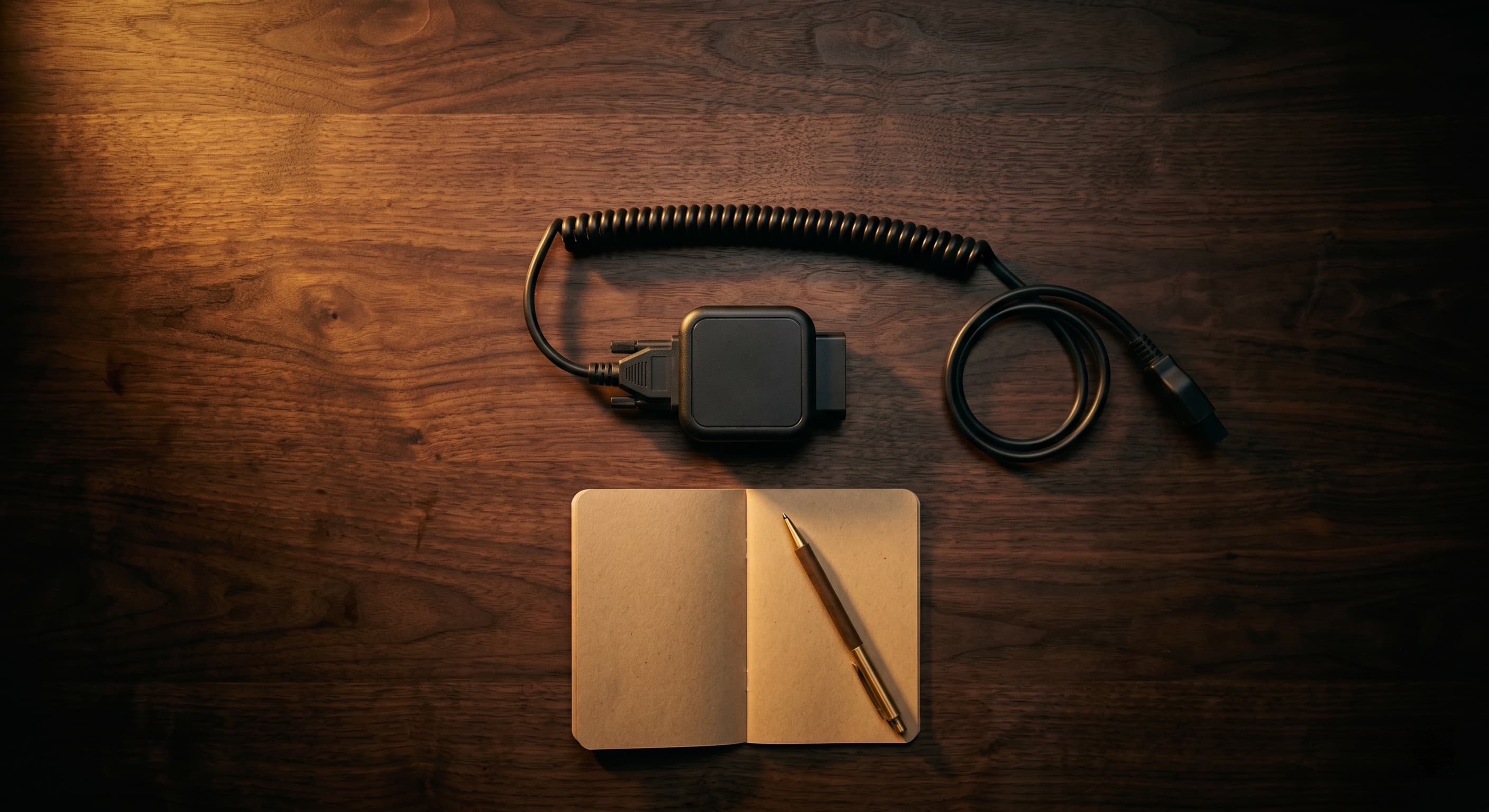
You don't need a mechanic to find out why your check engine light is on. A Bluetooth OBD2 scanner plugs into your car's diagnostic port and sends the trouble codes to your phone in under 60 seconds. The BAFX Products Bluetooth adapter costs $20–$25 on Amazon, works with any Android phone, and reads the same generic OBD-II codes that a shop's professional scanner reads. For iPhone users, the Veepeak OBDCheck BLE+ ($30) supports iOS via Bluetooth Low Energy.
Step by step:
-
Find the OBD-II port. It's a 16-pin trapezoidal connector under the dashboard on the driver's side, typically below the steering column. Federal standard SAE J1962 requires it within two feet of the steering wheel on every vehicle built after 1996.
-
Plug the scanner in with the ignition off. For Bluetooth scanners, pair the adapter with your phone and open your scanner app (Torque for Android, Car Scanner for iOS, or the adapter's own app).
-
Turn the ignition to "On" without starting the engine. For push-button start, press the start button without touching the brake pedal.
-
Tap "Read Codes." The scanner communicates with the ECU over the OBD-II protocol and pulls all stored and pending diagnostic trouble codes in 5–15 seconds.
-
Write down every code. Pending codes haven't triggered the check engine light yet but flag a developing problem. Stored codes are the active faults.
-
Look up each code in your scanner app or online. Generic codes (P0xxx) are standardized across all manufacturers. Manufacturer-specific codes (P1xxx) may require a factory-level scanner to interpret fully.
For a detailed comparison of scanners — including advanced options like the BlueDriver Pro ($85) that reads ABS and transmission codes — see our best OBD2 scanners guide.
A $20–$25 Bluetooth OBD2 scanner (BAFX Products for Android, Veepeak BLE+ for iPhone) reads the same generic trouble codes as a shop's professional scan tool. Plug it into the OBD-II port under your dashboard, open the app, and tap "Read Codes." In under 60 seconds you'll know whether you're dealing with a $15 gas cap or a $1,300 catalytic converter — before spending $150 on a shop diagnosis.
Check Engine Light Diagnosis and Repair Costs
A check engine code read is free at AutoZone, O'Reilly Auto Parts, and Advance Auto Parts — a staff member plugs a scanner into your OBD-II port in the parking lot and hands you a printout. This tells you the code but not the root cause. A P0171 (system too lean) could be a cracked vacuum hose, a dirty MAF sensor, or a failing fuel pump — the code alone doesn't distinguish between a $5 fix and a $400 one. For root-cause diagnosis, you need pinpoint testing.
| Where | What You Get | Cost |
|---|---|---|
| AutoZone / O'Reilly / Advance Auto | Code read only (no root-cause diagnosis) | Free |
| Your own Bluetooth OBD2 scanner | Code read + live sensor data on your phone | $20–$30 one-time |
| Independent mechanic | Code read + pinpoint testing to find root cause | $80–$150 |
| Dealership | Full diagnosis with factory scan tool and TSB lookup | $120–$200 |
Many independent shops apply the diagnosis fee toward the repair if you have the work done there. Ask before authorizing the diagnosis.
Once you know the root cause, here are the most common check engine light repairs and their national average costs per CarMD and RepairPal:
| Repair | Total Cost | Parts | Labor |
|---|---|---|---|
| Tighten or replace gas cap | $0–$25 | $0–$15 | $0 |
| Replace EVAP purge valve | $201–$240 | $50–$100 | $100–$150 |
| Replace oxygen sensor (one) | $434–$537 | $150–$250 | $200–$300 |
| Replace ignition coil(s) | $230–$330 | $50–$150 | $100–$200 |
| Replace spark plugs (full set) | $276–$391 | $30–$100 | $200–$300 |
| Replace mass airflow sensor | ~$303 average | $100–$200 | $100–$150 |
| Replace catalytic converter | $2,164–$2,483 | $1,500–$2,000 | $200–$500 |
Catalytic converter costs vary by vehicle. A Ford F-150 averages $1,655–$1,737 per RepairPal. A Honda Civic runs $2,500–$3,337 because Honda uses an integrated exhaust manifold/catalytic converter assembly on those models. Before paying out of pocket, check two things: your car may still be under the federal emissions performance warranty (8 years or 80,000 miles for catalytic converters and PCMs under the Clean Air Act), and there may be an active NHTSA recall covering the repair. Pinion monitors NHTSA recalls by VIN and sends an alert if your vehicle is affected — worth checking before writing a $2,000 check.
AutoZone, O'Reilly, and Advance Auto Parts read check engine codes for free — walk in, ask for a code scan, and a staff member plugs a reader into your OBD-II port in the parking lot. You'll have your code in two minutes. A full diagnosis with pinpoint testing to identify the actual failed component runs $80–$150 at an independent shop or $120–$200 at a dealership.
When to Keep Driving and When to Pull Over
If your check engine light is solid and the car drives normally — no shaking, no power loss, no overheating, no unusual sounds — you can drive safely to a shop or auto parts store for a code read. Over half of all check engine light triggers are emissions-related faults (catalytic converter degradation, EVAP leaks, oxygen sensor aging) that don't affect how the car drives in the short term.
Three questions to ask yourself:
-
Is the light flashing? Pull over immediately. A flashing CEL means active misfire and real-time catalytic converter damage with every mile you drive.
-
Any drivability symptoms? Rough idle, vibration, power loss, or a climbing temperature gauge alongside a solid CEL means something beyond a routine emissions fault. Get to a shop the same day.
-
Solid light, car runs fine? Read the code yourself with a $20 scanner or stop by AutoZone for a free scan. Codes like P0420, P0440, P0442, and P0135 give you a week or two to schedule a repair.
After the Fix: Clearing Codes and Preventing Repeat Triggers
After a repair, the mechanic clears the stored codes with a scan tool. The check engine light turns off, but the OBD-II system needs to complete its drive cycle monitors before confirming the fix — typically 50–100 miles of mixed city and highway driving. If the light comes back, the root cause wasn't fully addressed or there's a second fault.
If the same code returns within a week, get a second opinion at a different shop. A recurring P0171 lean code, for example, can point to an intermittent vacuum leak that's hard to catch without a smoke test ($50–$80 at most shops).
Following your manufacturer's recommended maintenance schedule prevents most check engine triggers. Worn spark plugs cause misfires. Clogged air filters contribute to lean conditions. Skipped coolant changes lead to thermostat codes. Most check engine problems trace back to deferred maintenance. Pinion loads your car's manufacturer-recommended maintenance schedule by VIN and sends push reminders before each service is due, so nothing gets missed.
Frequently Asked Questions
Can I drive with the check engine light on?
A solid check engine light with no drivability symptoms — no rough idle, no power loss, no overheating — is usually safe to drive on for a few days while you schedule a diagnosis. The most common causes (loose gas cap, failing oxygen sensor, EVAP leak) are emissions faults that won't damage the engine short-term. A flashing check engine light is a different situation: it signals an active misfire sending unburned fuel into the catalytic converter. Pull over and have the car towed. Driving with a flashing CEL can destroy the catalytic converter, which costs $1,000–$2,500 to replace.
What are the most common check engine light codes?
Per CarMD's 2026 Vehicle Health Index, the most common triggers are catalytic converter codes (P0420 — 6.26% of all CEL repairs, $1,313 average fix), oxygen sensor failures (P0135/P0137 — 6.16%), and ignition coil and spark plug issues (P0300–P0306 — 9.6% combined). EVAP system leaks (P0440/P0442) and mass airflow sensor faults round out the top five. Over half of all check engine codes are emissions-related rather than mechanical emergencies.
How much does it cost to diagnose a check engine light?
Code reads are free at AutoZone, O'Reilly, and Advance Auto Parts. A Bluetooth OBD2 scanner like the BAFX Products adapter costs $20–$25 and reads codes on your phone. For a full diagnosis — where a technician reads the code and performs pinpoint testing to isolate the root cause — an independent shop charges $80–$150 and a dealership charges $120–$200. Many shops apply the diagnosis fee toward the repair cost if you authorize the work.
What does a flashing check engine light mean?
A flashing check engine light means the engine is misfiring severely enough to damage the catalytic converter. Unburned fuel entering the exhaust superheats the converter's catalyst material and can destroy it within minutes. Pull over, shut off the engine, and have the car towed. The three most common causes: a failed ignition coil ($230–$330 per RepairPal), worn spark plugs ($276–$391 for a full set), or a faulty fuel injector ($200–$500). All three repairs cost far less than the catalytic converter they'll ruin ($2,164–$2,483 per RepairPal).
Frequently Asked Questions
Vlad Kuzin
Developer of Pinion. Writes about car maintenance to help people save money and stay safe on the road.