How to Jump Start a Car: Step-by-Step Guide
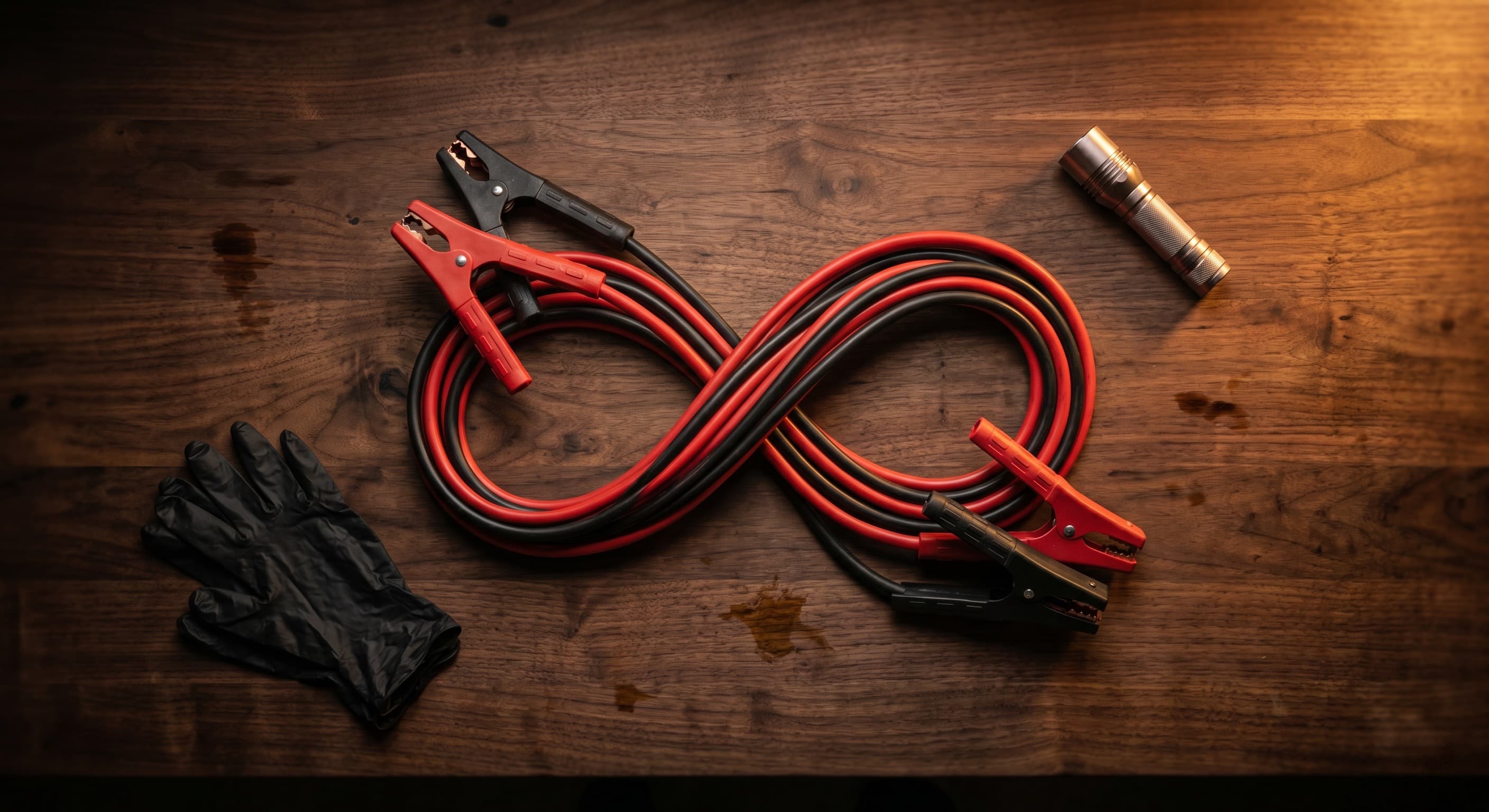
To jump start a car, you connect jumper cables in a specific order — red to dead positive, red to good positive, black to good negative, black to an unpainted engine ground — then start the working car, wait two minutes, and start the dead one. AAA responded to roughly 7 million battery-related roadside calls in 2024, making dead batteries the second most common reason drivers get stranded. Most of those situations are fixable in under 10 minutes if you have cables and follow the correct procedure.
But the cable order is only half the story. A frozen battery can explode when you send current through it. A swollen or cracked battery can spray sulfuric acid. And if you shut off the engine five minutes after a jump instead of driving for 20-30 minutes, you will be back where you started tomorrow morning. This guide covers the full procedure, the safety checks that most guides skip, and the situations where you should not jump start at all.
Before You Touch the Cables: Safety Checks
The most dangerous part of a jump start is not the electricity — it is the hydrogen gas. Lead-acid batteries vent hydrogen during normal discharge, and a spark at the terminal can ignite it. AAA's official jump start guide warns that connecting directly to a dead battery's negative terminal creates sparks that may cause an explosion. That is why the last cable always goes to an engine ground, not the battery.
Before connecting anything, inspect the dead battery:
- Cracks or leaking fluid: A cracked case means sulfuric acid is exposed. Do not jump — replace the battery.
- Swelling or bulging sides: Internal short circuits cause gas buildup that deforms the case. Jumping a swollen battery risks rupture.
- Frozen electrolyte: If the car sat overnight in sub-zero temperatures and the battery case feels rock-hard or the liquid inside looks slushy through the inspection window, the electrolyte is frozen. Jumping a frozen battery can cause it to explode. Bring it indoors to thaw before charging or testing.
- Rotten-egg smell: Hydrogen sulfide means the battery is overcharged or failing internally. Do not jump — replace it.
Never jump start a battery that is cracked, leaking, swollen, or frozen. A damaged lead-acid battery vents hydrogen gas and contains sulfuric acid — sparks from jumper cables can cause an explosion. If you see physical damage, skip the jump and go straight to replacement. A standard 12V car battery costs $150-$300 installed at most shops (AAA, 2025).
Wear safety glasses. Remove metal jewelry — a ring or watch that bridges a terminal to ground can arc-weld itself to your skin in milliseconds. Do not smoke near the battery. These are not theoretical risks: Consumer Reports' chief mechanic specifically warns that modern vehicles' complex electrical systems make jump starting riskier than it was a generation ago.
What You Need
You need one of two things: jumper cables and a second vehicle, or a portable jump starter. Here is what to look for in each.
Jumper Cables
AAA recommends heavy-duty 6-gauge cables at least 16 feet long. Thin 10-gauge cables — the cheapest ones at the gas station — are a frequent point of failure, especially on V6 or V8 engines or in cold weather. The thicker the gauge (lower number = thicker wire), the more current flows.
| Feature | Budget Cables | Recommended Cables |
|---|---|---|
| Gauge | 10-gauge | 6-gauge |
| Length | 12 feet | 16-20 feet |
| Price | $15-$25 | $30-$50 |
| Clamp type | Stamped steel | Copper-plated, spring-loaded |
| Cold weather performance | Poor — high resistance | Reliable |
| Best for | Emergency backup only | Regular use, larger engines |
A good set of 6-gauge, 20-foot cables costs about $35-$45 at AutoZone or Amazon. They will last decades.
Portable Jump Starters
A portable lithium jump starter lets you jump start a car by yourself without a second vehicle. The NOCO Boost Plus GB40 is the benchmark in this category: 1,000 peak amps, handles gas engines up to 6.0 liters and diesels up to 3.0 liters, weighs 2.4 pounds, and costs $75-$100 depending on the retailer. It also functions as a USB power bank and includes a 100-lumen LED flashlight.
For larger engines, the NOCO GBX45 adds 1,250 peak amps and faster USB-C charging for around $110-$130. The GOOLOO GP2000, at $60-$80, offers 2,000 peak amps on paper and handles gas engines up to 8.0 liters — though "peak amps" lacks an industry-standard measurement method, so cross-brand comparisons are unreliable.
A portable jump starter like the NOCO GB40 ($75-$100, 1,000 peak amps) eliminates the need for a second vehicle and fits in a glove box. It provides up to 20 jump starts per charge and includes spark-proof connections with reverse-polarity protection. For V8 engines or diesel trucks, step up to the GBX45 (1,250 peak amps, ~$120) or higher.
How to Jump Start a Car with Jumper Cables
Park the working car close enough for cables to reach both batteries. The vehicles should not touch. Turn off the ignition, headlights, and all accessories on both cars. Set both parking brakes. Automatic transmissions go in Park; manual transmissions in Neutral.
The Cable Connection Order
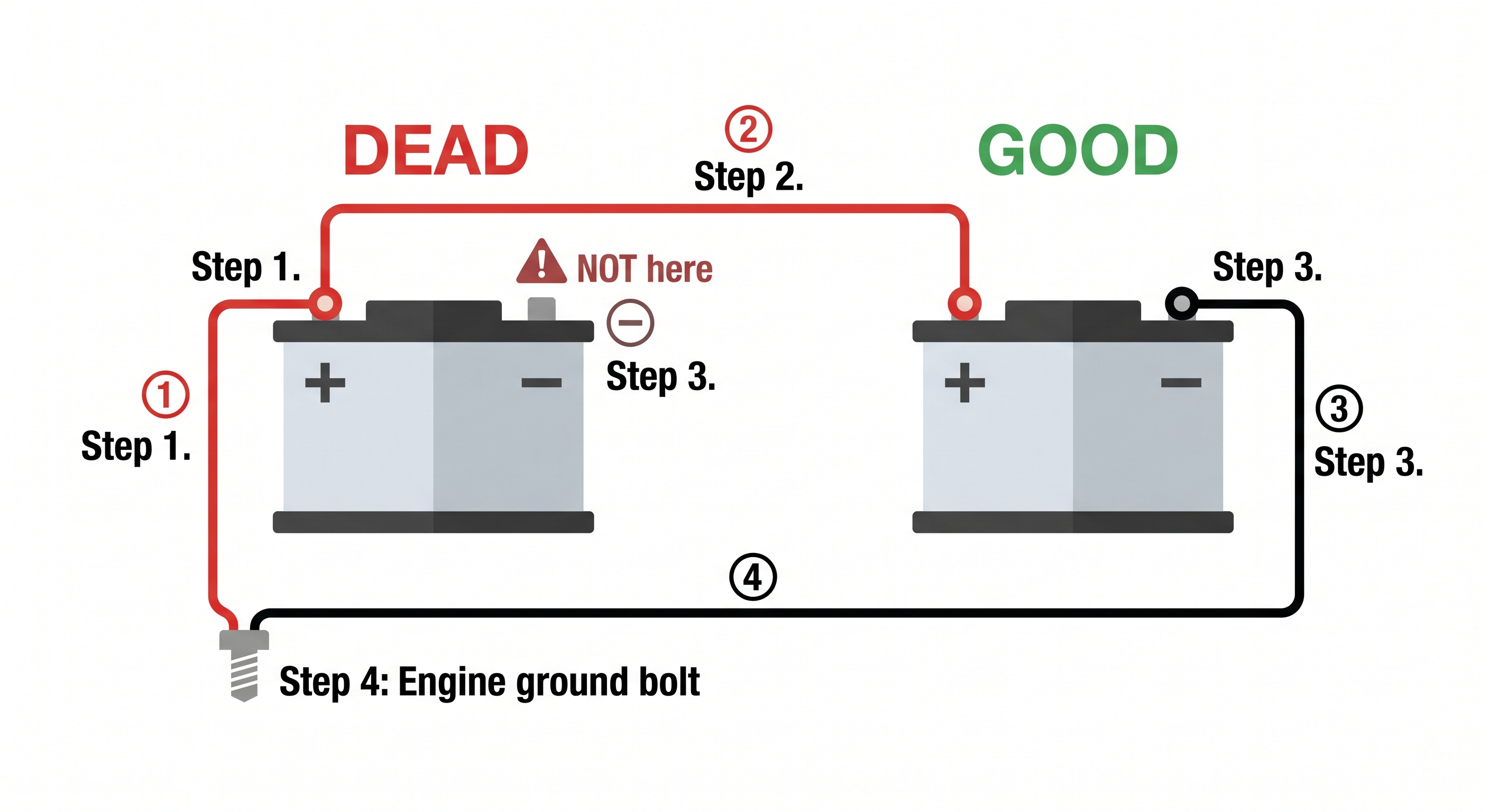
This is the step that matters most. Connect in this exact sequence:
- Red clamp → dead battery's positive (+) terminal. The positive terminal is marked with a "+" and usually has a red cover.
- Red clamp → good battery's positive (+) terminal. Same identification — look for the "+" mark.
- Black clamp → good battery's negative (-) terminal. The negative terminal is marked with a "-".
- Black clamp → unpainted metal on the dead car's engine block. Find a bolt, bracket, or engine lift hook at least 12 inches from the battery. This is your ground point. Do not connect to the dead battery's negative terminal — this is where hydrogen gas concentration is highest, and the spark from connecting could ignite it.
The fourth cable always goes to bare metal on the engine block — never the dead battery's negative terminal. Batteries vent hydrogen gas during discharge, and the spark from the final connection can ignite it. A bolt on the engine block, an alternator bracket, or a designated ground point (marked in your owner's manual) are all safe targets. Look for unpainted, non-moving metal.
Starting the Car
- Start the working vehicle. Let it idle for 2-3 minutes — this builds a surface charge on the dead battery through the cables.
- Try starting the dead car. Crank for no more than 5 seconds at a time. Extended cranking overheats the starter motor.
- If it does not start, wait 2-3 minutes and try again. After three failed attempts, the battery is likely beyond jump starting and needs replacement.
- Once the dead car starts, leave both cars running for another minute before disconnecting.
Disconnecting the Cables
Remove cables in the reverse order of connection:
- Black clamp from the engine ground (dead car)
- Black clamp from the good battery's negative terminal
- Red clamp from the good battery's positive terminal
- Red clamp from the dead battery's positive terminal
Do not let the clamps touch each other or any metal surface while disconnecting.
How to Jump Start a Car with a Portable Jump Starter
A portable unit simplifies the process because you are only dealing with one battery and one set of connections. No second car, no coordinating with a stranger in a parking lot.
- Turn off the jump starter and the car's ignition. All accessories off.
- Connect the red clamp to the dead battery's positive (+) terminal.
- Connect the black clamp to an unpainted metal ground point on the engine block — the same location you would use with cables.
- Turn on the jump starter. Most units have a power button or switch. The NOCO GB40's LED indicator will show green when it detects a valid connection.
- Start the car. Crank for no more than 5 seconds. If it does not start, wait 2 minutes and try again. Most portable units allow 2-3 attempts before they need to rest and recharge.
- Disconnect in reverse: turn off the jump starter, remove the black clamp, then the red clamp.
Portable starters with spark-proof connections and reverse-polarity protection (the GB40 and GBX45 both have these) will not deliver current if you accidentally connect the cables backward. This makes them meaningfully safer than traditional cables for inexperienced users.
What to Do After a Jump Start
Starting the car is only step one. If you turn the engine off in your driveway five minutes later, you will have a dead battery again by morning.
Drive for at least 20-30 minutes. The alternator recharges the battery while the engine runs, but it produces significantly more current at driving RPMs (1,500-2,000 RPM) than at idle (600-800 RPM). AAA recommends keeping the car running for at least 30 minutes after a jump. Highway driving is ideal — consistent speed, higher RPMs, no stop-and-go drain from accessories.
Do not turn off the engine prematurely. If you need to stop for gas, keep the engine running at the pump (where safe and legal) or accept that you may need a second jump.
Test the battery within 24 hours. If the car will not start again the next morning, the battery is dead — not discharged, dead. AutoZone, O'Reilly, and most independent shops test batteries for free. A battery showing less than 12.4 volts at rest or failing a load test needs replacement. Most shops charge $150-$300 installed for a standard 12V battery, depending on the vehicle.
Pinion tracks your battery's age based on when you log the install and can send a reminder when it approaches the 3-5 year typical lifespan — a useful heads-up before you end up stranded.
Jump Starting Hybrid and EV 12V Batteries
Hybrids and plug-in hybrids still use a 12V lead-acid (or AGM) battery to power the starter system, locks, and computers. When that 12V battery dies, the car will not enter "Ready" mode. You can jump it — but the procedure differs from conventional vehicles.
Check the owner's manual first. Toyota hybrids (Prius, RAV4 Hybrid, Camry Hybrid) have a designated jump terminal under the hood — a red terminal marked "+" in a fuse box — even though the 12V battery itself is in the trunk or under the rear seat. Honda hybrids often locate the 12V battery under the rear seat or in the trunk. Connecting cables to the wrong point can trigger a "Check Hybrid System" warning or confuse the battery management system.
Never touch the orange high-voltage cables. The high-voltage battery (200-400V) is completely separate from the 12V system. It has orange cabling for identification. Only certified technicians should service it.
After jumping, leave the hybrid in "Ready" mode for 20-30 minutes to let the DC-DC converter (which replaces a traditional alternator) recharge the 12V battery.
If you own a hybrid, a portable jump starter is the better choice over cables. It avoids the risk of voltage spikes from a second vehicle's alternator, which can damage sensitive hybrid electronics.
Cost Comparison: Jump Start Options
| Method | Cost | What You Need | Best For |
|---|---|---|---|
| Jumper cables + second car | $30-$50 (one-time cable purchase) | Cables, a willing helper | Home, parking lots with other drivers |
| Portable jump starter (NOCO GB40) | $75-$100 (one-time) | Charged jump starter | Solo drivers, tight parking, hybrids |
| Portable jump starter (GOOLOO GP2000) | $60-$80 (one-time) | Charged jump starter | Budget option, large engines |
| AAA roadside assistance | $0 with membership ($68-$133/year) | AAA membership, phone | Drivers who prefer professional help |
| Non-member roadside service | $50-$120 per call | Phone | One-off emergencies |
| Tow to shop (if battery cannot be jumped) | $109 average for 5 miles (AAA, 2025) | Phone, patience | Damaged battery, electrical fault |
A $75 portable jump starter pays for itself after a single roadside service call. Pinion's car maintenance schedule can help you track battery age alongside other service intervals so you catch a failing battery before it leaves you stranded.
When NOT to Jump Start
Not every dead battery should be jumped. In these situations, jumping can damage the battery, the vehicle, or you:
Frozen battery. If the car has been sitting in temperatures below 0°F (-18°C) and the battery case is rigid or the electrolyte looks icy through the inspection window, the battery is frozen. Sending current through a frozen battery builds internal pressure with no way to vent. The result can be a cracked case or, in extreme cases, an explosion. Bring the battery indoors and let it thaw to room temperature before charging or testing.
Cracked or leaking battery. Sulfuric acid on the battery tray, white crystalline buildup around the terminals, or visible cracks in the case all mean the battery is compromised. Jump starting will not fix structural damage.
Swollen battery. A battery case bulging outward indicates internal short circuits and gas buildup. Do not jump — replace immediately.
Repeated jump starts. If you have jumped the same battery three or more times in a month, the battery is failing. A new battery ($150-$300 installed) is cheaper than the tow you will eventually need when the jump stops working. Read our full guide on battery replacement costs and signs.
Electrical smell or smoke. If you smell burning plastic or see smoke from the engine bay after connecting cables, disconnect immediately. This indicates a short circuit in the wiring, not a dead battery.
Preventing Dead Batteries
A dead battery is almost always preventable. Here is what actually works:
- Replace batteries proactively at 4-5 years. Most car batteries last 3-5 years. AAA data shows that extreme heat (not cold) is the primary killer — summer heat accelerates chemical degradation, and the weakened battery then fails on the first cold morning of fall.
- Check terminal connections annually. Loose or corroded terminals increase resistance, which means incomplete charging. Clean corrosion with a baking soda paste and tighten connections to the manufacturer's torque spec.
- Avoid short trips. Frequent drives under 10 minutes do not give the alternator enough time to fully recharge the battery. If your commute is short, consider a battery maintainer ($25-$40) plugged in overnight.
- Turn off accessories before shutting off the engine. Headlights and cabin lights left on are still the #1 cause of dead batteries. Many modern cars turn these off automatically, but not all — check your owner's manual.
Frequently Asked Questions
What is the correct order to connect jumper cables?
Connect in this order: (1) Red clamp to the dead battery's positive (+) terminal. (2) Red clamp to the good battery's positive (+) terminal. (3) Black clamp to the good battery's negative (-) terminal. (4) Black clamp to an unpainted metal surface on the dead car's engine block — not the dead battery's negative terminal. This final connection away from the battery prevents sparks near hydrogen gas that batteries vent during discharge.
How long should you let a car run after a jump start?
Drive for at least 20-30 minutes to let the alternator recharge the battery. Idling alone is not enough — the alternator produces more current at driving RPMs (1,500-2,000 RPM) than at idle (600-800 RPM). Highway driving at consistent speed is ideal. If the car will not start again the next day, the battery needs replacement, typically $150-$300 installed.
Can you jump start a car with a portable battery pack?
Yes. Portable lithium jump starters like the NOCO GB40 ($75-$100, 1,000 peak amps) can start gas engines up to 6.0 liters without a second vehicle. Connect red to the positive terminal, black to an engine ground point, power on the unit, then start the car. These are safer than cables because there is no risk of incorrect cross-connection between two electrical systems.
When should you NOT jump start a car?
Do not jump start if the battery is cracked, leaking, frozen, or visibly swollen — a damaged battery can explode. Do not jump a car that has been sitting in sub-zero temperatures without confirming the electrolyte is not frozen. Also avoid jumping hybrid or EV 12V systems without checking the owner's manual — Toyota Prius models, for example, have a specific jump terminal in the engine bay fuse box, and connecting elsewhere can damage the battery management system.
Frequently Asked Questions
Vlad Kuzin
Developer of Pinion. Writes about car maintenance to help people save money and stay safe on the road.