Brake Pad Replacement: Cost, Signs, and When to Replace (2026 Guide)
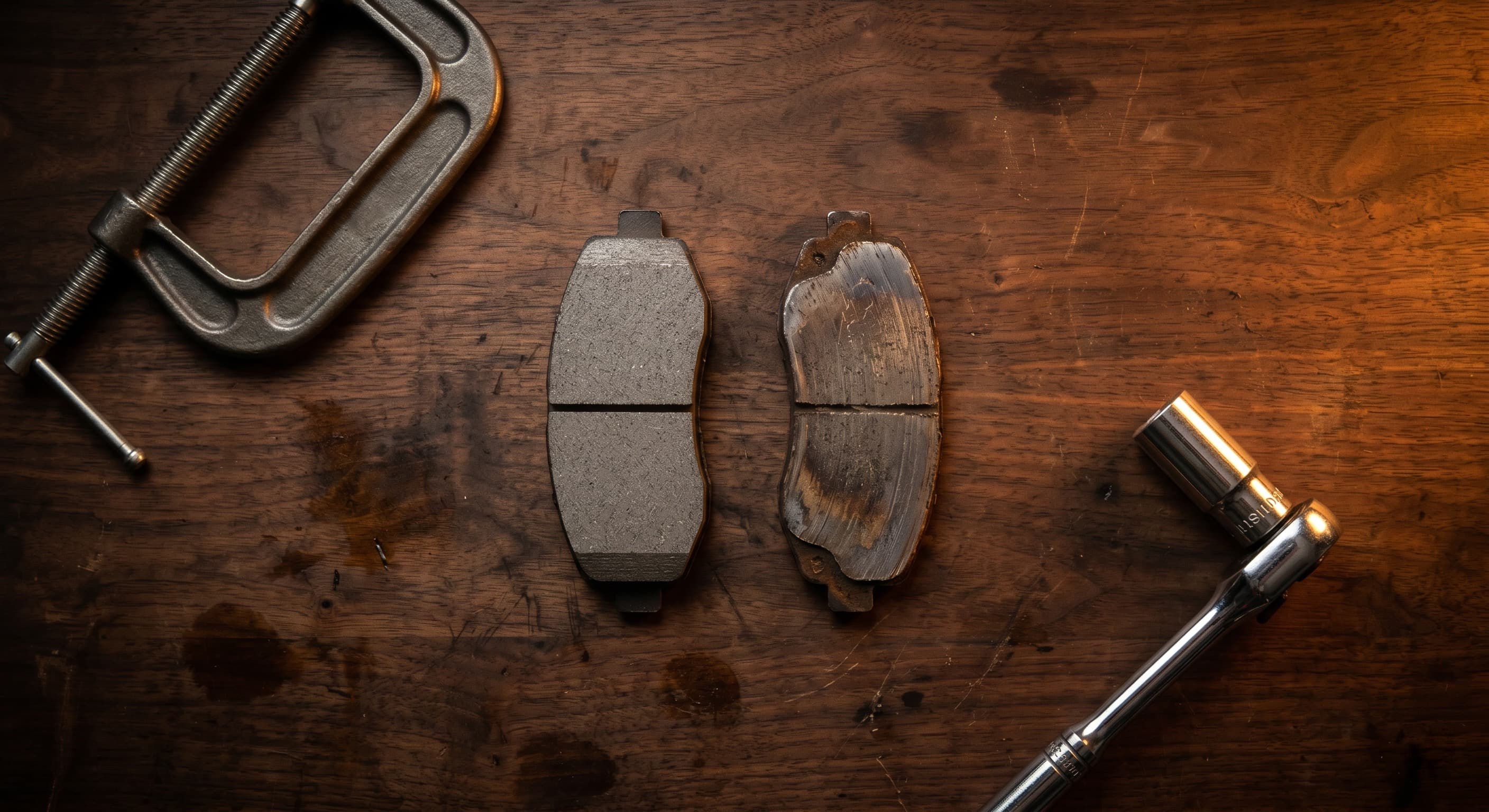
Your brakes are the most critical safety system on your vehicle. Knowing when to replace brake pads and how much it should cost protects both your safety and your wallet — and brake inspections are a key part of any full maintenance schedule. This guide covers brake pad replacement costs, warning signs of worn pads, the different pad types, and whether you should replace rotors at the same time.
How Much Does Brake Pad Replacement Cost?
Brake pad replacement is priced per axle (front or rear). Here are the national average costs for 2026:
| Service | Independent Shop | Dealership | DIY (Parts Only) |
|---|---|---|---|
| Front pads only | $150-$300 | $200-$400 | $40-$100 |
| Rear pads only | $150-$300 | $200-$400 | $40-$100 |
| Pads + rotors (per axle) | $300-$600 | $400-$750 | $150-$300 |
| All four corners (pads + rotors) | $600-$1,200 | $800-$1,500 | $300-$600 |
Cost by Chain
Prices vary significantly between national chains. Most offer lifetime pad warranties, meaning you only pay for labor on future replacements:
| Shop | Pads Only (per axle) | Pads + Rotors (per axle) | Warranty |
|---|---|---|---|
| Meineke | $130-$500 | $345-$500 | Varies |
| Pep Boys | $209-$250 | $350-$435 | Lifetime pads; 6mo labor |
| Midas | $200-$219 | $350-$400 | Lifetime pads |
| Firestone | $250-$320 | $350-$450 | Up to lifetime |
| Jiffy Lube | N/A | $370-$410 | 24mo/24K parts; 12mo/12K labor |
Cost by Vehicle
The biggest price swings come from the vehicle itself. A Honda Accord brake job costs a third of what BMW charges — not because the labor is harder, but because European vehicles use more expensive components and often require rotor replacement (rather than resurfacing) at every pad change:
| Vehicle | Pads Only (per axle) | Pads + Rotors (per axle) |
|---|---|---|
| 2017 Honda Accord | $295-$346 | $552-$630 |
| 2015 Toyota RAV4 | $255-$302 | $584-$669 |
| 2014 Ford Taurus | $256-$301 | $621-$711 |
| 2018 Chevy Tahoe | $256-$301 | $705-$808 |
| 2019 Audi Q7 | $293-$301 | $865-$977 |
| 2019 BMW 3 Series | — | $1,058-$1,179 |
Estimates from Endurance Warranty and RepairPal, 2026.
What Affects the Price?
- Vehicle type: Economy cars are cheapest. Trucks and SUVs cost more due to larger components. Luxury and European vehicles (BMW, Mercedes, Audi) cost significantly more due to premium parts and specialized labor.
- Pad material: Ceramic pads cost more than semi-metallic but last longer and produce less dust. OEM-equivalent pads cost more than budget aftermarket options.
- Rotor condition: If rotors can be reused, you save $150-$350 per axle. Rotors that are warped, scored, or below minimum thickness must be replaced.
- Additional work: Brake caliper replacement ($200-$400 per caliper), brake fluid flush ($80-$150), and brake hardware kits ($15-$30) add to the total when needed.
When to Replace Brake Pads
Mileage Guidelines
Brake pad lifespan varies widely based on driving conditions:
- City driving (heavy traffic, frequent stops): 25,000-40,000 miles
- Mixed driving (suburban commute): 40,000-60,000 miles
- Highway driving (minimal braking): 60,000-80,000 miles
Front brake pads wear faster than rear pads because the front brakes handle 60-70% of the vehicle's braking force due to weight transfer during deceleration. Front pads wear roughly 2-3x faster than rears on most vehicles.
Pad wear is also non-linear. A pad that took 40,000 miles to wear from 12mm (new) to 7mm can wear from 7mm to 3mm in only 15,000 miles. Thinner pads run hotter, transfer more heat to the caliper, and shed material faster. Don't assume the second half of pad life lasts as long as the first.
Warning Signs of Worn Brake Pads
Don't rely solely on mileage. Watch and listen for these signs:
- Squealing or squeaking sound: Most brake pads have a built-in metal wear indicator that contacts the rotor when pads are thin, producing a high-pitched squeal. This is your first warning.
- Grinding or metal-on-metal sound: If you hear grinding, the pad material is completely worn and metal is contacting the rotor. This is damaging your rotors and requires immediate attention.
- Brake warning light: Many modern vehicles have electronic brake pad wear sensors that trigger a dashboard warning light when pads reach minimum thickness.
- Longer stopping distances: If your car takes noticeably longer to stop, worn pads may be the cause.
- Vibration when braking: Pulsing in the brake pedal or steering wheel usually indicates warped rotors rather than worn pads, but the two often go together.
- Vehicle pulling to one side: Uneven pad wear can cause the car to pull left or right during braking.
Visual Inspection
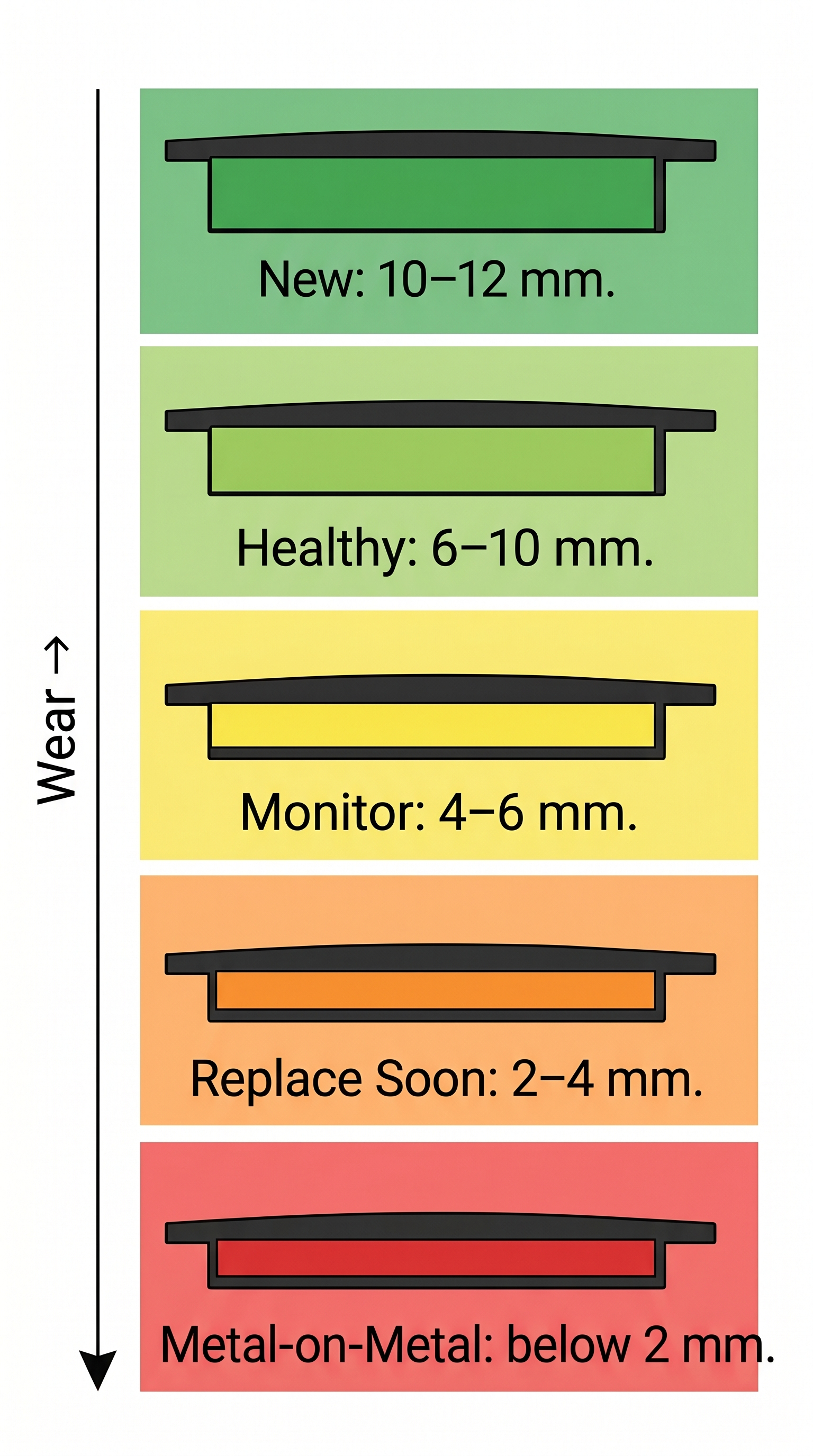
On many vehicles, you can visually inspect brake pad thickness by looking through the wheel spokes:
- 10-12mm: New pad — no action needed
- 6-10mm: Healthy — normal wear
- 4-6mm: Monitor — start planning replacement
- 2-4mm: Replace soon — wear indicator will begin squealing around 3mm
- Below 2mm: Metal-on-metal — rotor damage is occurring
If you can see that the pad is thinner than the metal backing plate, replacement is overdue.
Brake Pad Types
Ceramic Pads
Ceramic brake pads are made from ceramic fibers, bonding agents, and small amounts of copper fiber. They are the most popular choice for passenger vehicles.
Pros: Quiet operation, low brake dust, long lifespan, consistent performance across temperatures, gentle on rotors.
Cons: Higher upfront cost ($30-$80 per set), slightly less initial bite than semi-metallic in cold conditions.
Best for: Daily drivers, commuter vehicles, and anyone who wants clean wheels and quiet braking.
Semi-Metallic Pads
Semi-metallic pads contain 30-65% metal (steel, iron, copper) mixed with friction modifiers and fillers. They offer strong braking performance but at some tradeoffs.
Pros: Excellent stopping power, good heat dissipation, performs well in a wide temperature range, lower cost ($20-$50 per set).
Cons: More brake dust, noisier, harder on rotors (may shorten rotor life).
Best for: Trucks, SUVs, towing vehicles, and performance-oriented driving.
Organic (NAO) Pads
Organic or Non-Asbestos Organic pads use materials like glass, rubber, carbon, and Kevlar. They are the softest and quietest option.
Pros: Very quiet, gentle on rotors, lowest cost.
Cons: Shorter lifespan, more dust, fade under heavy braking or heat.
Best for: Light-duty vehicles with gentle driving patterns.
Copper-Free Pads (2025 Regulation)
As of January 1, 2025, all brake pads sold in California and Washington must contain less than 0.5% copper by weight (down from less than 5% in 2021). Copper dust from brake pads kills salmon and aquatic organisms in waterways. All major pad manufacturers have signed an EPA agreement to meet this standard nationally. If you're buying pads today, they already comply — but if you're comparing older forum recommendations to current product lines, be aware that formulations have changed.
Should You Replace Rotors Too?
This is one of the most common questions during a brake service. The answer depends on rotor condition:
When You Can Reuse Rotors
- Rotor thickness is above the minimum specification stamped on the rotor
- No deep grooves or scoring visible on the friction surface
- No warping (you would feel this as pedal pulsation)
- Rotors are not rusted through on the edges
When You Should Replace Rotors
- Rotor thickness is at or near the minimum specification
- Visible deep grooves or scoring that you can catch a fingernail on
- Pedal pulsation indicating warped rotors
- Severe rust or corrosion on the friction surface
- Rotors have already been resurfaced once (they cannot be resurfaced again)
Replacing pads on thin rotors is false economy. The thin rotor cannot absorb and dissipate heat effectively, leading to brake fade, faster pad wear, and potential safety issues.
If a shop tells you rotors "always" need replacement with every brake pad change, get a second opinion. Many rotors last through two sets of pads if properly maintained.
DIY Brake Pad Replacement
Brake pad replacement is one of the more accessible DIY jobs for home mechanics. Most front brake pad replacements take 1-2 hours with basic hand tools.
Tools You Need
- Floor jack and jack stands
- Lug wrench
- Socket set (typically 14mm-19mm for caliper bolts)
- C-clamp or brake caliper piston tool
- Brake cleaner spray
- High-temperature brake grease
- Torque wrench
Basic Steps
- Loosen lug nuts, lift and secure the vehicle on jack stands
- Remove the wheel
- Remove caliper bolts and hang the caliper with a wire (never let it hang by the brake hose)
- Remove old pads and note their orientation
- Compress the caliper piston with a C-clamp
- Install new pads with appropriate shims and hardware
- Reinstall caliper and torque bolts to specification
- Reinstall wheel and torque lug nuts
- Pump the brake pedal several times before driving to seat the pads
Always replace pads on both sides of the same axle. Never replace just one side, as this causes uneven braking and is a safety hazard.
Mistakes That Ruin a DIY Brake Job
Not pumping the brake pedal before driving. When you compress the caliper piston to fit new pads, the piston moves away from the rotor. The first press of the brake pedal pushes it to the floor with zero braking force. Pump the pedal 5-10 times until it feels firm before moving the car. Forum posts document near-crashes from skipping this step.
Letting the caliper hang by the brake hose. The caliper weighs 5-10 lbs. Hanging it by the rubber brake line strains the hose internally, causing restriction or failure that may not appear until weeks later. Use a wire hanger or bungee cord to support the caliper from the spring or strut.
Skipping rotor cleaning. New rotors ship with an oily anti-corrosion coating. Installing new pads against an oily rotor contaminates the pad surface and causes glazing, noise, and reduced stopping power. Spray every new rotor with brake cleaner and wipe dry before installation.
Not lubricating caliper slide pins. Dry slide pins cause the caliper to bind, dragging one pad while the other barely contacts the rotor. The result: one pad wears to metal in 15,000 miles while the other looks fine.
Skipping the bedding-in procedure. New pads must transfer an even layer of friction material onto the rotor surface. Make 6-10 moderate stops from 30 mph, allowing 30 seconds of cooling between each stop. Then drive gently for 100-200 miles. Skipping this causes pedal pulsation, vibration, and uneven wear.
How to Make Brake Pads Last Longer
- Coast before braking. Lift off the accelerator early and let the car slow naturally before applying brakes.
- Avoid riding the brakes on downhill grades. Use a lower gear to let engine braking share the load.
- Maintain following distance. More space means less hard braking.
- Keep your braking system maintained. Flush brake fluid every 2-3 years and keep calipers lubricated so they release fully. Schedule brake inspections alongside your tire rotation — they're on the same interval.
- Track your brake maintenance. Use an app like Pinion to log brake services and get reminders based on your vehicle's schedule.
Hybrids and EVs: Brakes That Last 100,000+ Miles
Regenerative braking on hybrids and EVs converts kinetic energy back into battery charge, reducing friction brake use by as much as 70%. The result is dramatically longer pad life — but a corrosion problem that ICE owners rarely face.
Toyota Prius: A poll in the Facebook Prius Club found 60% of owners went over 100,000 miles on original pads. 20% exceeded 200,000 miles. One documented case: 186,917 miles on original brakes with no pad change — though the owner found asymmetric wear from stuck caliper slide pins, proving that "brakes last forever" is dangerous oversimplification.
Tesla: A 2015 Model S owner reported 181,000 miles on original brakes. Others report first front brake work around 117,000 miles under normal driving. But in salt-belt states, Tesla owners replace brakes at 50,000-65,000 miles — not from pad wear, but from rotor corrosion. When friction brakes are used so infrequently, rust builds up on the rotor surface and eats into the metal. Chevy uses special anti-corrosive rotor coatings on the Bolt to combat this.
Tesla recommends caliper cleaning and lubrication annually (or every 12,500 miles in salt regions) and a brake fluid test every 4 years — a different maintenance rhythm than ICE vehicles.
Brake Service Scams to Watch For
A California Bureau of Automotive Repair investigation found 1 in 3 brake shops recommended unnecessary repairs on vehicles that had recently passed brake inspections, with an average unnecessary repair cost of $680.
The most common tactics:
- Mandatory rotor replacement. Claiming rotors must always be replaced with pads. Reality: rotors above minimum thickness specification can be reused. Many rotors last through two sets of pads.
- $99 bait-and-switch. Advertised at $99, then the quote jumps to $800 after "inspection." Documented at multiple shops in California.
- Phantom brake fluid flush. Claiming contamination based on fluid color alone. A legitimate test uses a moisture test strip showing greater than 3% water content — takes seconds and costs nothing.
- Caliper "seizure" diagnosis. Often the caliper only needs slide pin cleaning and lubrication ($20 in grease), not a $300-$400 caliper replacement.
You have the legal right to keep your old parts — in California, shops are required to return them on request. If a shop refuses, they may be hiding that the "replaced" parts were never actually replaced.
If a shop's initial quote doubles after they have your car apart, ask them to show you the problem. A legitimate shop will show you the worn part and explain the measurement. If they can't produce your old rotors or explain the minimum thickness spec, get a second opinion before authorizing work.
What Brake Pads Actually Cost Per Mile
A $250 pad replacement every 50,000 miles costs 0.5 cents per mile. A $600 pad-and-rotor job from waiting too long costs 1.2 cents per mile — and that's before accounting for the safety risk. NHTSA data attributes 22% of vehicle defect-related crashes to brake problems. Budget $150-$300 per axle at an independent shop for pads only, or $300-$600 per axle if rotors are needed. Don't ignore warning signs like squealing, grinding, or longer stopping distances. Catching worn pads early saves money by preserving your rotors and keeps you safe on the road.
Frequently Asked Questions
Vlad Kuzin
Developer of Pinion. Writes about car maintenance to help people save money and stay safe on the road.