Tire Rotation: Cost, Patterns, and How Often to Rotate (2026 Guide)

Tire rotation is one of the cheapest maintenance tasks you can do, and skipping it is one of the most expensive mistakes. Regular rotations even out tread wear across all four tires, extending their lifespan by thousands of miles and maintaining safe handling and traction.
This guide covers how often to rotate, the correct rotation pattern for your vehicle, what it costs, and how to do it yourself.
How Much Does a Tire Rotation Cost?
Tire rotation is one of the most affordable maintenance services:
| Where | Cost |
|---|---|
| Independent tire shop | $25-$50 |
| Dealership | $30-$60 |
| Chain (Discount Tire, Firestone, etc.) | $20-$40 |
| Costco / Sam's Club (with tire purchase) | Free |
| DIY | Free (tools required) |
Many tire retailers include free lifetime rotations when you purchase a set of tires from them. Ask about this before buying tires, as it can save you $100-$200 over the life of the tires.
How Often Should You Rotate Your Tires?
The standard recommendation is every 5,000-7,500 miles. This conveniently aligns with every other oil change for most vehicles — see our full maintenance schedule for all recommended intervals.
Manufacturer Recommendations
Most automakers specify a rotation interval in the owner's manual:
- Toyota/Lexus: Every 5,000 miles
- Honda/Acura: Every 7,500 miles
- Ford/Lincoln: Every 7,500 miles
- GM (Chevrolet, GMC, etc.): Every 7,500 miles
- Hyundai/Kia: Every 7,500 miles
- BMW/Mercedes: Varies; some models use staggered (non-rotatable) tire setups
If your vehicle has staggered tires (different sizes front and rear), traditional rotation is not possible. Some owners of staggered setups swap left-to-right on the same axle, but only if the tires are not directional. Check your owner's manual.
Signs You Need a Rotation Sooner
- Visible uneven tread wear (one edge wearing faster than the other)
- Vehicle pulling slightly to one side
- Increased road noise from tires
- Vibration at highway speeds
Tire Rotation Patterns
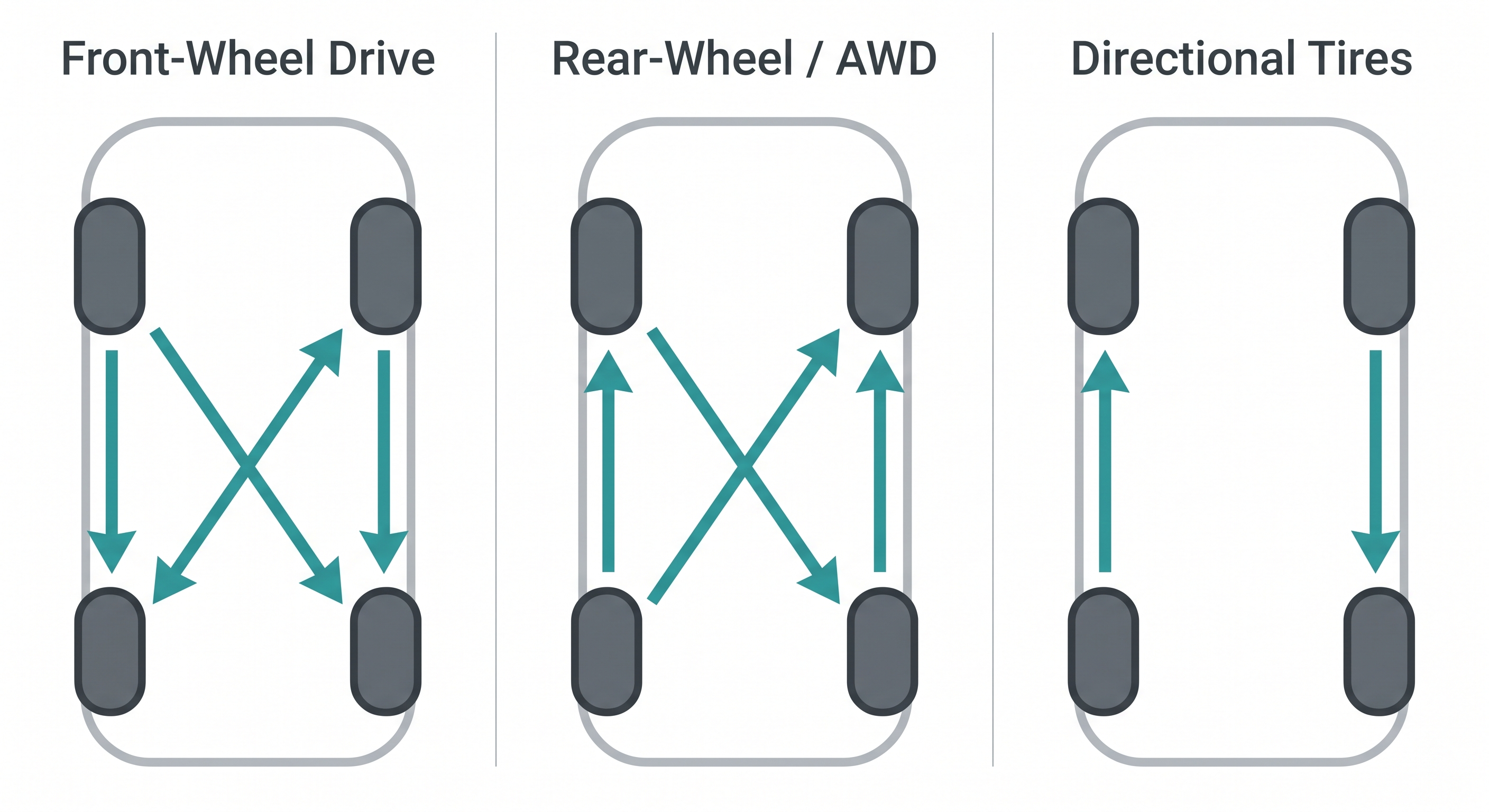
Using the correct rotation pattern ensures even wear. The right pattern depends on your drivetrain and tire type.
Front-Wheel Drive (FWD)
The front tires do most of the work: steering, accelerating, and the majority of braking. They wear faster, especially on the outer edges.
Pattern: Move the front tires straight back to the rear. Move the rear tires to the front, crossing them to opposite sides.
Front Left  → Rear Left
Front Right → Rear Right
Rear Left   → Front Right
Rear Right  → Front Left
Rear-Wheel Drive (RWD) and All-Wheel Drive (AWD)
Rear-drive and all-wheel-drive vehicles distribute wear differently. The rear tires handle acceleration forces while the front tires handle steering wear.
Pattern: Move the rear tires straight forward. Move the front tires to the rear, crossing them to opposite sides.
Rear Left   → Front Left
Rear Right  → Front Right
Front Left  → Rear Right
Front Right → Rear Left
Directional Tires
Directional tires have a tread pattern designed to rotate in one direction only (indicated by an arrow on the sidewall). They cannot be crossed to the other side.
Pattern: Swap front-to-back on the same side.
Front Left  ↔ Rear Left
Front Right ↔ Rear Right
Staggered Tires (Different Front/Rear Sizes)
If your front and rear tires are different sizes (BMW M3/M4, Mercedes AMG, Porsche 911, Corvette), you cannot rotate front-to-back. If the tires are non-directional, you can swap left-to-right on each axle. If they are both staggered and directional, rotation is not possible — you simply replace tires as they wear. Budget accordingly: without front-to-rear rotation, rear tires on performance cars wear significantly faster and may need replacement every 15,000-20,000 miles.
Why Tire Rotation Matters
Extends Tire Life
Front tires on a FWD vehicle can wear 20-30% faster than the rears. Without rotation, you end up replacing two tires at 30,000 miles while the rears still have 60% tread life. Regular rotation means all four tires wear evenly and can be replaced as a full set at 50,000-60,000+ miles.
On a set of tires costing $600-$800, this can save $300-$400 by avoiding premature partial replacements.
Maintains Even Handling
Uneven tread depth between the front and rear tires affects handling balance, especially in wet conditions. Rotating tires keeps tread depth consistent across all four corners, maintaining predictable braking and cornering grip. Since rotations and brake inspections share the same interval, many shops check pad thickness during a rotation — see our brake pad replacement guide for what to look for.
Required for Tire Warranties
Most tire manufacturers require proof of regular rotation to honor treadwear warranties — and the requirements are specific:
- Michelin: Every 6,000-8,000 miles. Must present a completed "Mounting and Rotation Service Record" from the owner's manual, plus the original purchase receipt.
- Continental: Every 6,000-8,000 miles. Must present a completed, legible rotation schedule. Tires older than 72 months are excluded regardless of mileage.
- Bridgestone: Every 5,000 miles. Proof must show date, mileage, and servicing location.
- Goodyear: Maximum intervals of 6,000 miles. Self-rotators must keep written records noting date, mileage, and rotation pattern.
Continental's warranty also has a detail that catches staggered-setup owners off guard: rear-axle tires on staggered fitments receive only 50% of the standard mileage warranty because they cannot be rotated front-to-rear.
Consumer Reports treadwear testing found that drivers who rotate consistently at every oil change get about 58,000 miles from 60,000-mile warranted tires. Inconsistent rotators averaged 45,000 miles — a 13,000-mile gap from the same tire.
AWD Vehicles: Why Rotation Is Non-Negotiable
On all-wheel-drive vehicles, skipping rotations creates a problem that goes beyond uneven wear. AWD systems rely on all four tires having nearly identical rolling circumference. When tread depth varies significantly between axles, the center differential operates as if the vehicle is constantly slipping — generating heat until internal components seize.
Subaru's requirement is the most strict and well-documented: all four tires must be within 2/32" of tread depth of each other, with rolling circumference within 1/4 inch. A center differential repair on a Subaru costs $4,000-$5,000. BMW xDrive specifies no more than 2mm difference.
If you damage one tire on an AWD vehicle and the remaining three have uneven wear from skipped rotations, you may be forced to replace all four. Tire Rack offers tire shaving ($25-$35 per tire) to match a new tire's tread depth to your existing set — but shaving voids the treadwear warranty on the shaved tire. Still cheaper than four new tires or a differential rebuild.
On a Subaru, Audi, or BMW xDrive, a single damaged tire at 25,000 miles with unrotated, unevenly worn remaining tires can force a full 4-tire replacement ($900+). If you ran the mismatch long enough to damage the center differential: $4,000-$5,000. The $35 rotation every 5,000 miles prevents all of this.
EVs Wear Tires Differently
Electric vehicles are heavier (battery packs add 20-30% more weight than a comparable ICE drivetrain) and deliver instant torque. The result: EVs wear tires 20-40% faster than equivalent gas-powered cars. A survey found 39% of EV owners replaced tires in the last year, compared to 20% of ICE owners.
Tesla recommends rotation every 6,250 miles or when tread depth difference exceeds 1.5mm (2/32"). Model Y Performance owners on Tesla forums report needing replacement at 16,000 miles — a third of what most ICE sedan tires last. Rivian R1T/R1S owners have reported burning through tires in as little as 6,000 miles, with the vehicle's 7,000+ lb curb weight as the primary factor.
EV-specific tires also cost 30% more on average. A set of Michelin Pilot Sport EV tires runs $720-$1,000, compared to $520-$720 for the non-EV Pilot Sport 4 S. Combined with faster wear rates, EV owners face roughly double the annual tire cost of ICE owners — making rotation even more critical.
One-pedal driving adds another variable. Regenerative braking transfers weight forward more aggressively than conventional braking, increasing front tire wear. On rear-wheel-drive EVs (single-motor Tesla Model 3, base Rivian), the rear tires handle all acceleration torque while the fronts absorb regenerative braking loads — both axles wear fast, but for different reasons. Consistent rotation is the only way to keep wear balanced.
DIY Tire Rotation
Tire rotation is one of the easiest DIY maintenance tasks. You need minimal tools and it takes about 20-30 minutes.
Tools Required
- Floor jack
- Two jack stands (four is easier but not required)
- Lug wrench or impact wrench
- Torque wrench
- Chalk or marker to label tire positions (optional but helpful)
Step-by-Step
- Park on a flat, hard surface. Engage the parking brake.
- Loosen all lug nuts slightly (about 1/4 turn) while the car is on the ground.
- Lift one axle at a time. Place jack stands under the vehicle's designated jack points.
- Remove wheels and move them to their new positions following the correct rotation pattern for your drivetrain.
- Hand-tighten lug nuts in a star pattern to seat the wheel evenly.
- Lower the vehicle and torque lug nuts to the manufacturer's specification (typically 80-100 ft-lbs for passenger cars, 120-140 ft-lbs for trucks).
- Check tire pressures and adjust to the specification on the driver's door jamb sticker.
If you only have two jack stands, you can still rotate tires. Lift the front axle first, place the front tires aside, lower the front, then lift the rear. Move rear tires to the front, then place the set-aside tires on the rear.
TPMS After Rotation
If your vehicle uses direct TPMS (a physical pressure sensor in each wheel), the system needs to relearn which sensor is at which position after a rotation. Without relearn, the dashboard may show the wrong tire as low — a safety issue. About 38% of vehicles auto-relearn by driving a few miles, 27% require an OBD-II scan tool, and 35% require a TPMS activation tool ($30-$80). Sensors must be activated in a specific sequence — typically LF, RF, RR, LR — and tire pressure must be within 5 PSI of the door placard value before starting. Vehicles with indirect TPMS (which use ABS wheel speed sensors instead of dedicated sensors) do not need relearn after rotation.
Tire Rotation vs Wheel Alignment vs Tire Balancing
These three services are often confused but serve different purposes:
| Service | What It Does | How Often | Cost |
|---|---|---|---|
| Tire rotation | Moves tires to different positions for even wear | Every 5,000-7,500 miles | $25-$50 |
| Wheel alignment | Adjusts suspension angles so tires contact the road correctly | Every 1-2 years or after hitting a pothole/curb | $80-$150 |
| Tire balancing | Adds small weights to wheels to eliminate vibration | When tires are mounted or when vibration occurs | $40-$80 (all four) |
Rotation and alignment work together, but they solve different problems. Rotation distributes wear evenly; alignment prevents abnormal wear in the first place. Even 0.3 degrees of toe misalignment causes the tire to scrub sideways with every mile driven, wearing the inside edge to near-bald while the outside looks fine. A tire that passes a visual inspection from the curb can be dangerously worn on the inner edge. If you're rotating on schedule but still seeing uneven wear, the alignment is the likely cause.
$50 Now or $900 Later
Tire rotation costs $25-$50 every 5,000-7,500 miles and extends tire life by 20-30%. On a $900 set of tires, that's $180-$270 saved in additional tread life — from a service that takes 20-30 minutes as a DIY job. On an AWD vehicle, the stakes are even higher: mismatched tread depths from skipped rotations can force a full 4-tire replacement or a multi-thousand-dollar differential repair. Follow the correct rotation pattern for your drivetrain, keep your rotations on schedule, and use an app like Pinion to track when your next rotation is due.
Frequently Asked Questions
Vlad Kuzin
Developer of Pinion. Writes about car maintenance to help people save money and stay safe on the road.