How Often to Change Your Oil (Real Intervals by Car)
Most modern vehicles need an oil change every 7,500-10,000 miles with full synthetic oil, or once a year — whichever comes first. No manufacturer of a car built after 2010 recommends 3,000-mile oil changes with synthetic oil. The 3,000-mile rule dates from the 1970s, when engines ran conventional oil with looser tolerances and weaker additive packages. It persists because quick-lube chains profit from more frequent visits and because old habits outlast the conditions that created them. A 2012 NPD Group survey found that 51% of U.S. car owners still believed in the 3,000-mile interval, down from 59% in 2007 — a slow decline for a myth that costs drivers hundreds of dollars a year.
Why the 3,000-Mile Rule Is Wrong
The 3,000-mile oil change interval made sense for 1970s engines running conventional oil rated API SA or SB. Those early formulations broke down faster, contained fewer detergent additives, and degraded under high temperatures. Modern full synthetic oils — rated API SP (introduced 2020) and certified ILSAC GF-6 by the American Petroleum Institute — last 7,500-15,000 miles while maintaining viscosity, preventing sludge, and protecting against low-speed pre-ignition in turbocharged engines. The oil changed. The advice didn't.
Edmunds investigated this directly after interviewing oil engineers, mechanics, and automakers. Their conclusion: the 3,000-mile interval is outdated for any vehicle using synthetic oil. Scientific American reported the same finding — quick-lube chains recommend 3,000 miles, automakers specify 5,000-7,500, and synthetic oil manufacturers stand behind 10,000-15,000. The incentive structure explains the gap. Jiffy Lube operates over 2,000 U.S. locations. Valvoline Instant Oil Change runs another 1,600+. These businesses earn revenue per visit. A customer coming every 3,000 miles generates 2-3x more revenue than one following a 10,000-mile manufacturer schedule.
No manufacturer of a vehicle built after 2010 recommends 3,000-mile oil changes with synthetic oil. Modern full synthetic oils rated API SP are engineered to last 7,500-15,000 miles. The 3,000-mile rule dates from the era of conventional oil and looser engine tolerances. Follow your owner's manual interval — not the sticker a quick-lube shop puts on your windshield.
Manufacturer Oil Change Intervals for 20 Popular Vehicles
Every manufacturer publishes oil change intervals in the owner's manual, and none of them say 3,000 miles for synthetic oil. The table below shows the actual recommended intervals for 20 of the best-selling vehicles in the United States, with separate columns for normal and severe driving conditions. All data comes from current owner's manuals and official manufacturer maintenance schedules.
| Vehicle | Normal Interval | Severe Interval | Oil Spec |
|---|---|---|---|
| Toyota Camry | 10,000 mi / 12 mo | 5,000 mi | 0W-20 synthetic |
| Toyota RAV4 | 10,000 mi / 12 mo | 5,000 mi | 0W-20 synthetic |
| Toyota Corolla | 10,000 mi / 12 mo | 5,000 mi | 0W-20 synthetic |
| Toyota Highlander | 10,000 mi / 12 mo | 5,000 mi | 0W-20 synthetic |
| Toyota Tacoma | 10,000 mi / 12 mo | 5,000 mi | 0W-20 synthetic |
| Honda Civic | 7,500-10,000 mi / 12 mo | Per Maintenance Minder | 0W-20 synthetic |
| Honda CR-V | 7,500-10,000 mi / 12 mo | Per Maintenance Minder | 0W-20 synthetic |
| Honda Accord | 7,500-10,000 mi / 12 mo | Per Maintenance Minder | 0W-20 synthetic |
| Ford F-150 | 7,500-10,000 mi / 12 mo | 5,000-7,500 mi | 5W-30 synthetic blend |
| Ford Explorer | 7,500-10,000 mi / 12 mo | Per IOLM | 5W-30 synthetic blend |
| Chevrolet Silverado | 7,500 mi / 12 mo | Per OLM | 0W-20 synthetic |
| Chevrolet Equinox | 7,500 mi / 12 mo | Per OLM | 0W-20 or 5W-30 |
| Hyundai Tucson | 7,500 mi / 12 mo | 3,750 mi / 6 mo | 0W-20 synthetic |
| Hyundai Elantra | 7,500 mi / 6 mo | 4,500 mi / 6 mo | 0W-20 synthetic |
| Kia Sportage | 7,500-10,000 mi / 6 mo | 5,000 mi / 3 mo | 0W-20 synthetic |
| Nissan Rogue | 5,000 mi / 6 mo | Per IOLM | 0W-20 synthetic |
| Nissan Altima | 5,000-7,500 mi / 12 mo | 5,000 mi | 0W-20 synthetic |
| Jeep Grand Cherokee | 7,500-10,000 mi / 6 mo | 5,000-7,500 mi | 0W-20 synthetic |
| Subaru Outback | 6,000 mi / 6 mo | 3,000-5,000 mi | 0W-20 synthetic |
| BMW 3 Series | 10,000-15,000 mi / 12 mo | Per CBS | BMW LL-01 synthetic |
Three patterns stand out. Toyota is the most generous among mass-market brands — 10,000 miles across the entire lineup with 0W-20 synthetic, confirmed by Toyota's official support page. Nissan and Subaru are the most conservative: Nissan specifies 5,000 miles for the Rogue, and Subaru sets 6,000 miles for the Outback despite using the same 0W-20 oil grade as Toyota. BMW pushes the longest intervals — up to 15,000 miles — by using a physical oil quality sensor in its Condition Based Service (CBS) system rather than a mileage-based algorithm.
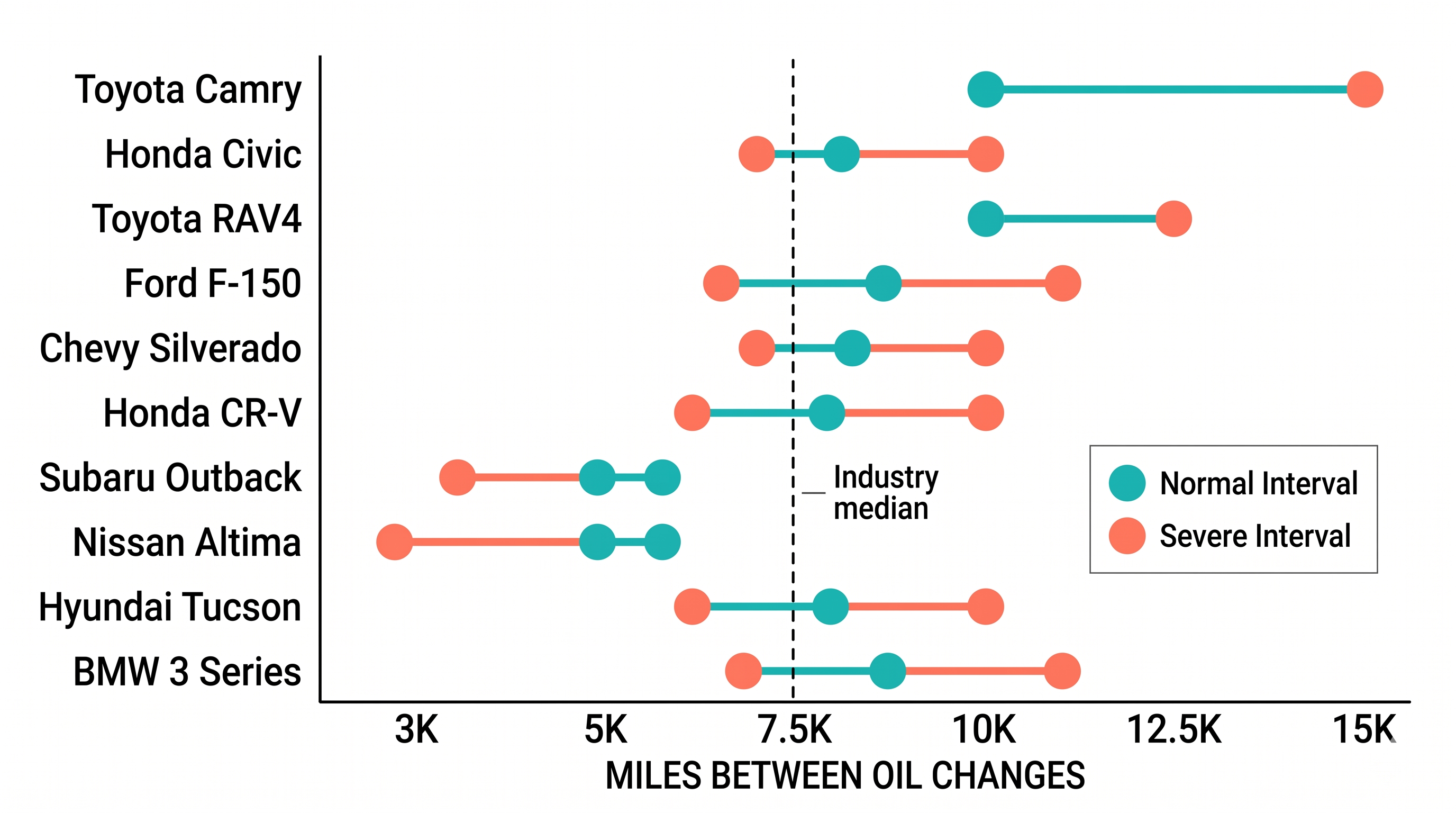
Toyota, Honda, and Hyundai specify 7,500-10,000-mile oil change intervals for most models with 0W-20 synthetic under normal conditions. BMW allows up to 15,000 miles. No vehicle on this list calls for 3,000 miles with synthetic oil. Check your owner's manual for your exact interval — or use an app like Pinion, which loads your manufacturer's schedule from your VIN.
If your vehicle isn't listed above, look up the interval in your owner's manual (usually in the "Maintenance" or "Service and Appearance Care" chapter) or check our complete car maintenance schedule guide.
Normal vs. Severe Service: Which Schedule Applies to You?
Manufacturers publish two maintenance schedules: normal and severe (sometimes labeled "Special Operating Conditions" or "Schedule B"). The severe schedule cuts the oil change interval roughly in half — from 10,000 miles to 5,000 on a Toyota, or from 7,500 to 3,750 on a Hyundai. Most drivers assume they fall under "normal," but the severe conditions list is broader than it sounds. If more than half your driving matches any of the following, you belong on the severe schedule.
Severe driving conditions, as defined across Toyota, Honda, GM, and Hyundai owner's manuals:
- Short trips under 10 miles — engine never reaches full operating temperature
- Stop-and-go traffic — frequent acceleration and braking cycles
- Dusty, gravel, or unpaved roads
- Towing a trailer or carrying heavy loads
- Extreme temperatures — consistently above 90°F or below 0°F
- Extended idling — delivery vehicles, drive-throughs, long warm-ups
If most of your driving is short trips under 10 miles, you qualify as severe service — even if you drive gently. Short trips prevent the engine from reaching the 200°F+ operating temperature needed to boil off fuel dilution and moisture from the oil. Urban commuters with 5-mile commutes should follow the severe schedule, not the normal one.
The short-trip threshold catches the most people. A 5-mile commute each way means the engine oil never fully heats up. Fuel vapors and water condense in the crankcase and degrade the oil faster than highway miles. This is why time-based intervals exist alongside mileage intervals — a car that sits in a garage still needs an annual oil change because oxidation and moisture accumulation don't stop when the odometer does. The severe schedule also applies to other fluids: transmission fluid intervals are similarly shortened under severe conditions.
How Oil Type Affects Your Change Interval
Conventional oil (API Group I/II base stocks) holds up for 3,000-5,000 miles. Synthetic blend extends that to 5,000-7,500 miles. Full synthetic (Group III/IV/V base stocks) lasts 7,500-15,000 miles, depending on the engine and manufacturer's specification. Nearly every new car sold today ships with full synthetic from the factory — the 10,000-mile interval that Toyota specifies is only possible with synthetic chemistry.
The difference is structural, not marketing. Synthetic base stocks have uniform molecular chains, which deliver more stable viscosity across temperature extremes, better resistance to thermal and oxidative breakdown, and fewer carbon deposits on internal engine surfaces. A 2017 AAA study tested synthetic and conventional oils under controlled conditions and found that synthetic oils outperformed conventional by an average of 47% across standard industry tests.
For a deeper comparison of oil types — including when switching from conventional to synthetic makes sense — see our guide to synthetic vs. conventional oil.
Most vehicles built since 2010 specify either 0W-20 or 5W-30 full synthetic. If your owner's manual calls for 0W-16 (increasingly common in newer Toyota models for fuel economy), that is a full synthetic-only viscosity grade — conventional oil is not available in that weight. The API SP and ILSAC GF-6 certifications printed on the oil bottle confirm the oil meets the latest performance standards, including protection against low-speed pre-ignition (LSPI) in turbocharged and direct-injection engines.
What an Oil Change Costs (and How the Wrong Interval Wastes Money)
A full synthetic oil change costs $65-$125 at an independent mechanic, $70-$100 at a quick-lube shop, or $100-$200 at a dealership, based on Kelley Blue Book's 2026 cost data. DIY oil changes cost $35-$50 in parts: a 5-quart jug of synthetic oil and a filter.
| Service Venue | Conventional | Synthetic Blend | Full Synthetic |
|---|---|---|---|
| Quick-lube (Jiffy Lube, Valvoline) | $45-$50 | $65-$80 | $70-$100 |
| Independent mechanic | $35-$75 | $55-$95 | $65-$125 |
| Dealership | $75-$100 | $90-$130 | $100-$200 |
| DIY (parts only) | $20-$30 | $25-$40 | $35-$50 |
Prices: Kelley Blue Book 2026, Jiffy Lube published pricing 2025.
The wrong interval wastes real money. Here's a worked example:
The average American drives 13,500 miles per year (Federal Highway Administration). At the 3,000-mile quick-lube recommendation, that's 4-5 oil changes a year. At $75 per full synthetic service, that totals $338-$375/year. At the Toyota-recommended 10,000-mile interval, it's 1-2 visits — $75-$150/year. Following the manufacturer interval saves $188-$225 per year, or $1,880-$2,250 over a 10-year ownership period.
Following a 10,000-mile manufacturer interval instead of the outdated 3,000-mile rule saves $188-$225 per year on a vehicle driven 13,500 miles annually — assuming $75 per full synthetic oil change at a quick-lube. Over 10 years, that's $1,880-$2,250 in unnecessary spending eliminated by reading your owner's manual.
If you do your own oil changes, the math gets even better. A DIY synthetic change costs about $40 in parts — $25-$35 for a 5-quart jug of Mobil 1, Pennzoil Platinum, or Castrol Edge 0W-20 and $7-$12 for a filter. Two changes per year on a 7,500-mile interval runs $80/year total — less than the cost of a single quick-lube visit.
For a full breakdown of oil change costs by vehicle type and labor rates, see our complete oil change cost guide.
How Oil Life Monitoring Systems Work
Most vehicles built after 2010 include an oil life monitoring system that calculates when your oil needs changing based on actual driving conditions — not a fixed mileage sticker. These systems track engine RPM, coolant temperature, ambient temperature, trip length, and elapsed time to model oil degradation in real time. When the system says it's time, change the oil. When it doesn't, don't.
The four major systems work differently:
- Honda Maintenance Minder — displays oil life as a percentage on the dashboard. At 15% remaining, a service reminder appears. Under mixed driving, this typically triggers between 7,500 and 10,000 miles.
- GM Oil Life Monitor (OLM) — algorithm-based system used across Chevrolet, GMC, Buick, and Cadillac. Displays "Change Engine Oil Soon" at approximately 15% remaining oil life.
- Ford Intelligent Oil-Life Monitor (IOLM) — algorithm-based with a hard cap of 10,000 miles or one year between changes, regardless of the monitor's reading.
- BMW Condition Based Service (CBS) — the most advanced system. Uses a physical oil quality sensor in the oil pan that measures electrical conductivity, combined with algorithms tracking engine load, fuel consumption, and distance. Allows up to 15,000 miles between changes.
These monitors are calibrated by the engineers who designed your engine. They factor in your actual driving conditions — short trips, highway cruising, towing, ambient temperature — which makes them more accurate than any fixed-mileage rule. If your vehicle doesn't have a built-in monitor, Pinion tracks your oil change interval based on your manufacturer's schedule and sends a push reminder before each service is due.
Frequently Asked Questions
Is it OK to change oil every 10,000 miles?
Yes, if your manufacturer specifies that interval and you use the recommended full synthetic oil. Toyota specifies 10,000 miles for the Camry, RAV4, Corolla, Highlander, and Tacoma with 0W-20 synthetic under normal conditions. Honda's Maintenance Minder system typically triggers between 7,500-10,000 miles. BMW's Condition Based Service allows up to 15,000 miles. The interval depends on the oil grade and engine design — a Nissan Rogue uses the same 0W-20 synthetic but Nissan sets a 5,000-mile interval. Check your owner's manual for the number specific to your vehicle.
Is the 3,000-mile oil change a myth?
For any modern vehicle using synthetic oil, yes. The 3,000-mile interval dates from the era of conventional oil and looser engine tolerances. No manufacturer of a vehicle made after 2010 recommends 3,000-mile intervals with synthetic oil. Edmunds, Consumer Reports, and Scientific American have all published investigations reaching the same conclusion. Quick-lube shops promote the shorter interval because it doubles visit frequency per customer. Follow your owner's manual.
How often should I change my oil if I don't drive much?
Change your oil at least once a year, even if you haven't reached the mileage interval. Oil degrades through moisture contamination and oxidation regardless of whether the car moves. Short trips under 10 miles are especially hard on oil because the engine never reaches the 200°F+ operating temperature needed to evaporate fuel dilution and condensation. If most of your driving consists of short trips, follow the severe service schedule — typically half the normal mileage interval (5,000 miles instead of 10,000 on a Toyota, for example).
Does the type of oil affect how often I change it?
The oil type is the single biggest factor after engine design. Conventional oil lasts 3,000-5,000 miles. Synthetic blend extends to 5,000-7,500 miles. Full synthetic — which most 2015+ vehicles require — lasts 7,500-15,000 miles. A Toyota Camry and a Subaru Outback both use 0W-20 synthetic, but Toyota sets a 10,000-mile interval while Subaru specifies 6,000. The manufacturer's interval accounts for the oil specification, engine geometry, and filtration system together. Always follow the owner's manual rather than the interval printed on the oil bottle.
Can I go longer than the manufacturer's recommended interval?
Extending beyond the manufacturer interval without data is a bad bet. The interval is calibrated for your specific engine's tolerances, oil specification, and filtration capacity. Exceeding it risks sludge buildup, accelerated bearing wear, and voided warranty coverage. If you want hard data on whether your oil has remaining life at the manufacturer's interval, send a used oil sample to Blackstone Labs (about $30 per analysis). Their report measures wear metals, viscosity breakdown, and contamination levels. Without oil analysis results, stick to the number in your owner's manual.
Frequently Asked Questions
Vlad Kuzin
Developer of Pinion. Writes about car maintenance to help people save money and stay safe on the road.