Oil Change: Cost, Intervals, and Everything You Need to Know (2026)

An oil change is the single most important routine maintenance you can do for your car. It is also one of the most affordable. Yet the old "every 3,000 miles" rule is outdated, and the real answer depends on your oil type, driving habits, and what your manufacturer recommends.
This guide covers everything you need to know: how much an oil change costs, how often to get one, synthetic vs conventional oil, and when to follow the severe service schedule.
How Much Does an Oil Change Cost?
Oil change costs vary by oil type, vehicle, and where you get the work done. Here are the national averages for 2026:
| Oil Type | Shop Cost | DIY Cost |
|---|---|---|
| Conventional | $35-$75 | $20-$35 |
| Synthetic Blend | $50-$90 | $30-$45 |
| Full Synthetic | $65-$125 | $35-$55 |
| European/Luxury | $100-$175+ | $50-$80 |
Price by Chain
Not all shops charge the same for the same service. A full synthetic oil change at Walmart costs roughly half what you'd pay at Jiffy Lube or Valvoline Instant:
| Provider | Conventional | Full Synthetic |
|---|---|---|
| Walmart (Pit Crew) | $23-$27 | $45-$59 |
| Meineke | $35 | $75 |
| Firestone | $30-$46 | $70-$100 |
| Pep Boys | $40-$45 | $85-$100 |
| Valvoline Instant | $45-$51 | $96-$100 |
| Jiffy Lube | $50-$58 | $90-$105 |
Vehicles requiring more than 5 quarts incur per-quart surcharges of $5-$10 at most chains. The price gap between Walmart and a quick-lube chain covers roughly 1-2 extra oil changes per year.
What Affects the Price?
Several factors push oil change costs higher or lower:
- Oil type: Full synthetic costs roughly twice as much as conventional oil, but lasts significantly longer.
- Oil capacity: Most sedans take 4-5 quarts. Trucks and SUVs often take 6-8 quarts. Some European vehicles take 8-10 quarts.
- Oil filter: Standard filters cost $5-$15. European vehicles often use cartridge-style filters that cost $10-$25.
- Location: Prices vary by region. Urban areas and coastal cities tend to cost 15-25% more than the national average.
- Shop type: Quick-lube chains are usually cheapest. Dealerships charge a premium but use OEM parts. Independent mechanics fall in between.
DIY vs Shop: Is It Worth Doing Yourself?
Doing your own oil change saves $30-$70 per service. For most vehicles, a DIY oil change takes 20-30 minutes and requires only basic tools: a socket wrench, drain pan, funnel, and jack stands.
The biggest DIY savings come from oil choice. Costco's Kirkland Signature full synthetic runs about $2.70 per quart (sold in 4x5-quart packs), compared to $6.58 per quart for Mobil 1 at the same store. Independent lab testing on BobIsTheOilGuy forums shows Kirkland full synthetic — manufactured by Warren Distribution and dexos1-certified — has zinc, phosphorus, and molybdenum additive levels comparable to name brands. A full DIY change with Kirkland costs under $22 for oil plus $5-$8 for a filter. The same change with Mobil 1 costs $38-$41.
The main tradeoffs are convenience and used oil disposal. Most auto parts stores accept used oil for free recycling — and proper disposal matters. One gallon of used motor oil can contaminate one million gallons of drinking water (CalRecycle). If you drive a vehicle with easy underbody access (like a truck or SUV), DIY is straightforward. Low-slung vehicles may require ramps or jack stands, adding time and complexity.
How Often Should You Change Your Oil?
The 3,000-mile oil change interval was reasonable decades ago when conventional oil and looser engine tolerances were the norm. Modern engines and modern oils have changed the equation dramatically — yet over 65% of drivers still follow the old rule, according to industry surveys. That gap between what engineers recommend and what drivers do costs American car owners an estimated $5.4 billion per year in unnecessary oil changes (Scientific American). California ran an official state campaign in 2008 specifically to tell drivers to stop changing oil too often.
Recommended Oil Change Intervals by Oil Type
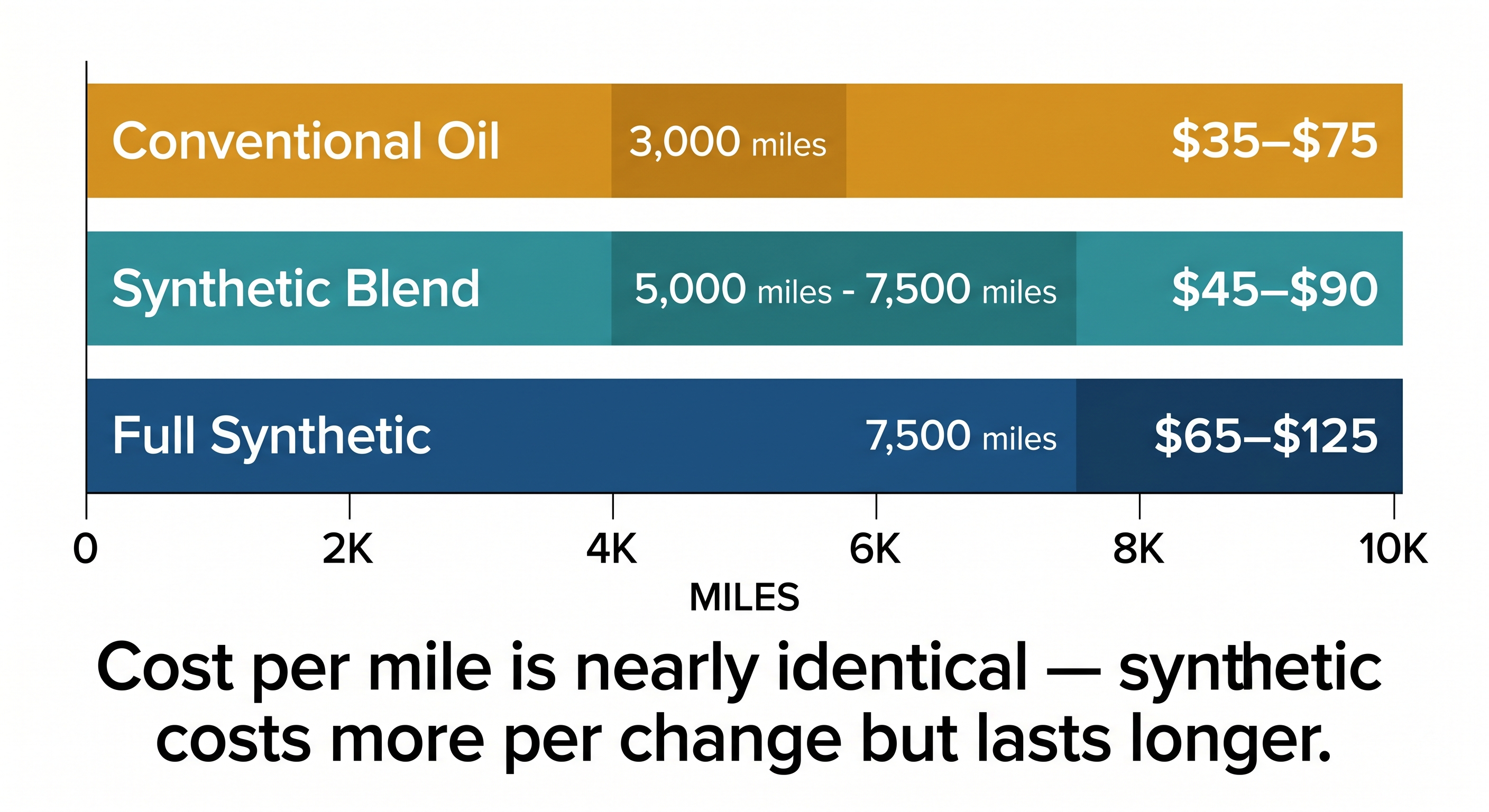
- Full Synthetic: 7,500-10,000 miles or 12 months
- Synthetic Blend: 5,000-7,500 miles or 12 months
- Conventional: 5,000-7,500 miles or 6-12 months
These are general guidelines. Your owner's manual is the definitive source for your specific vehicle. Some manufacturers specify intervals as long as 15,000 miles (BMW, Porsche) or as short as 5,000 miles.
The Severe Service Schedule
Most owner's manuals include two maintenance schedules: normal and severe (see our full maintenance schedule for every interval). The severe service schedule typically cuts oil change intervals by 40-50%. You should follow the severe schedule if your driving regularly includes any of these conditions:
- Short trips under 10 miles, especially in cold weather (the engine never fully warms up, allowing moisture and fuel to contaminate the oil)
- Stop-and-go city driving or heavy traffic commuting
- Dusty or gravel roads
- Extreme heat (sustained temperatures above 100F)
- Towing or carrying heavy loads
- Extended idling (delivery drivers, rideshare, etc.)
According to AAA, most drivers actually meet one or more severe service criteria without realizing it. If you are unsure, the severe schedule is the safer choice.
Oil Life Monitors
Most vehicles built after 2010 have an oil life monitoring system that tracks driving conditions and estimates when the oil needs changing. These systems account for trip length, engine temperature, RPM, and other factors to give you a more accurate interval than a simple mileage rule.
Consumer Reports recommends following your oil life monitor when available, but never exceeding 12 months between changes regardless of the monitor's reading, since oil degrades over time even when the car is not driven.
Synthetic vs Conventional Oil
Conventional Oil
Conventional motor oil is refined directly from crude oil. It provides adequate protection for most engines but breaks down faster under heat and stress. Conventional oil is suitable for older vehicles with simpler engine designs and shorter recommended intervals.
Best for: Older vehicles (pre-2010), vehicles with manufacturer specs calling for conventional oil, and budget-conscious owners who don't mind more frequent changes.
Synthetic Oil
Full synthetic oil is chemically engineered for consistent molecular structure. This gives it superior performance across a wide range of temperatures, better resistance to breakdown, and longer service life.
Best for: Most modern vehicles (2010+), turbocharged engines, vehicles driven in extreme temperatures, and anyone who wants longer intervals between changes.
Synthetic Blend
Synthetic blend oil mixes conventional and synthetic base stocks. It offers some of synthetic's benefits at a lower price point. Many manufacturers recommend synthetic blend as a minimum for their vehicles.
Best for: Trucks and SUVs, moderate-climate driving, and owners looking for a middle ground between cost and performance.
Does It Matter Which Brand You Use?
Not much, as long as the oil meets your vehicle's specification. What matters is the viscosity grade (like 0W-20 or 5W-30) and the API certification (look for the API donut on the bottle). Your owner's manual specifies the required viscosity grade. Using the wrong grade can affect fuel economy and engine protection.
Some manufacturers have their own oil specifications (BMW LL-01, Mercedes MB 229.5, VW 502.00). If your vehicle requires a manufacturer-specific spec, make sure the oil you use is certified to that standard.
The Oil Filter Matters More Than You Think
The filter matters as much as the oil, especially on extended drain intervals. Filters use either cellulose media ($3-$5) or synthetic media ($8-$15). Synthetic-media filters like the Purolator PureOne and Wix XP achieve 99% filtration efficiency for particles as small as 20 microns. Budget cellulose filters pass more debris, restrict flow sooner, and can limit how far you safely stretch a drain interval. If you're running 10,000+ miles between changes on full synthetic, a premium filter is not optional — it's what keeps that interval safe.
What Happens During an Oil Change?
A standard oil change includes:
- Draining the old oil through the drain plug at the bottom of the oil pan
- Replacing the oil filter to ensure contaminants are captured effectively
- Installing a new drain plug washer (often overlooked, but prevents leaks)
- Filling with new oil to the manufacturer's specified capacity
- Checking the oil level with the dipstick or electronic monitor
- Resetting the oil life monitor if equipped
A thorough shop will also perform a basic visual inspection of your vehicle's underside, check fluid levels, inspect the air filter, and may recommend brake service if pads are worn. Some shops include a tire pressure check and top-off of windshield washer fluid.
Quick-Lube Risks: What Can Go Wrong
A 4-month NBC4 hidden-camera investigation tested 11 Jiffy Lube locations in Los Angeles. Seven out of 11 attempted to sell unnecessary services. At one store, a customer who came in for a $22 oil change was quoted $649 in repairs. Hidden cameras caught a technician removing an old air filter, reinstalling the same dirty one, and charging $26.99 for a "new" replacement. At another location, a service advisor claimed the transmission and differential fluids were "pretty close to empty and really dirty" — hidden cameras showed no one ever inspected them. The customer was charged $200. This was NBC4's third investigation in three years; Jiffy Lube promised reform each time.
The upselling is structural, not incidental. Service advisors at many quick-lube chains earn little or no base salary — their pay comes as a percentage of each service sold.
Common upsells and what they're actually worth:
| Upsell Service | What They Charge | What It's Worth |
|---|---|---|
| Engine flush | $100-$150 | Not manufacturer-recommended; can block oil passages |
| Cabin air filter | $89-$150 at dealer | $7-$30 on Amazon, 2-minute DIY job |
| Fuel injector cleaning | $100-$150 | Modern gasoline already contains detergent additives |
| Transmission fluid change | $150-$250 | Honda, Toyota, and Nissan recommend against flush machines |
If a shop recommends any service beyond what your owner's manual calls for at your current mileage, ask them to show you where it appears in the manufacturer's maintenance schedule. If they can't, decline.
Check Your Oil Between Changes
Consumer Reports found that 39% of vehicle owners either never check their oil or only check it during service visits. That's a problem, because some engines consume oil as part of normal operation — and the thresholds manufacturers consider "acceptable" may surprise you:
- BMW: Up to 1 quart per 750 miles
- Audi: Up to 1 quart per 600-700 miles
- Subaru: Up to 1 quart per 1,000-1,200 miles
- Industry norm for most engines: 1 quart per 6,000-12,000 miles
Consumer Reports data on 2010-2014 vehicles found that 2% — roughly 1.5 million vehicles — had excessive oil consumption requiring top-offs between changes. Check your dipstick monthly, especially on turbocharged or direct-injection engines.
For a data-driven approach, Blackstone Laboratories offers used oil analysis for $30. Mail in a sample of your used oil at drain time, and their lab report tells you the remaining oil life (TBN), wear metal levels (iron, copper, tin), and whether contaminants like coolant or fuel are present. Their database of thousands of samples shows that oil degrades fastest in the first few thousand miles, then the rate of decline slows — meaning the second 5,000 miles is less destructive than the first 5,000.
Signs You Need an Oil Change
Don't wait for a warning light. Watch for these indicators:
- Oil life monitor reads 15% or less — schedule your change soon
- Dark, gritty oil on the dipstick — fresh oil is amber and translucent; dark, opaque oil has accumulated contaminants
- Engine noise — increased ticking or knocking at startup can indicate insufficient lubrication
- Oil change reminder light — don't ignore it, but also don't panic; you typically have a few hundred miles of margin
- Burnt oil smell — may indicate an oil leak or oil that has severely degraded
How to Save Money on Oil Changes
- Buy oil and filter yourself, then pay a shop for labor only. Some independent mechanics will do this, saving you the parts markup.
- Use oil change coupons. Dealerships and chains frequently offer $10-$20 off promotions, especially for new customers.
- Switch to synthetic and go longer between changes. Paying $80 every 10,000 miles costs less per mile than paying $45 every 5,000 miles.
- Do it yourself. Once you have the basic tools, DIY oil changes save $30-$70 per service.
- Track your intervals with an app. Using an app like Pinion to track your mileage and service dates ensures you change your oil when needed — not too early and not too late.
What an Oil Change Actually Costs You Per Mile
An oil change is cheap insurance for a $30,000+ asset. A full synthetic change at $80 every 10,000 miles costs 0.8 cents per mile — less than the cost of the gasoline you burn driving to the shop. Follow your owner's manual, use the correct oil type and viscosity, and don't fall for the outdated 3,000-mile myth. Most modern vehicles on synthetic oil can safely go 7,500-10,000 miles between changes under normal driving conditions.
If you are unsure about your vehicle's specific interval, check your owner's manual or use the Pinion app to look up OEM maintenance schedules for your make and model.
Frequently Asked Questions
Vlad Kuzin
Developer of Pinion. Writes about car maintenance to help people save money and stay safe on the road.