Coolant Flush: When You Need One and What It Costs
Most modern vehicles need a coolant flush every 5 years or 100,000 miles, and it costs $100–$200 at an independent shop. But shops frequently push 30,000-mile flush intervals — a schedule designed for the old green coolant (IAT) that hasn't been factory-fill since the late 1990s. Today's OAT, HOAT, and P-OAT formulations last far longer, but the real risk is putting the wrong type back in. Mixing incompatible coolant chemistries causes gel formation that can clog your radiator and damage your water pump.
How Much Does a Coolant Flush Cost?
A standard coolant flush runs $100–$200 at an independent shop, or $150–$300 at a dealership. The price gap comes down to labor rates, coolant cost, and whether you're getting a simple drain-and-fill or a full machine flush. European vehicles consistently cost more because they require OEM-specific coolant formulations that run $25–$40 per gallon instead of the $10–$15 that domestic and Japanese-spec coolant costs.
A coolant flush costs $100–$200 at an independent shop, $150–$300 at a dealership, or $30–$60 as a DIY job. The biggest cost variable is your coolant type: universal coolant runs $10–$15 per gallon, while European OEM coolant (BMW, Mercedes, Audi) costs $25–$40 per gallon. Labor typically takes 1–2 hours at $80–$150/hour.
| Service Type | Cost Range (2026) | What's Included |
|---|---|---|
| DIY drain-and-fill | $30–$60 | Coolant ($10–$25/gal), distilled water, drain pan |
| Independent shop — drain-and-fill | $80–$150 | Labor (1 hr), coolant, system inspection |
| Independent shop — full flush | $120–$200 | Machine flush, new coolant, pressure test |
| Dealership — full flush | $150–$300 | OEM coolant, full system flush, inspection |
| European vehicle (dealer) | $200–$400 | OEM-specific coolant ($25–$40/gal), longer procedure |
RepairPal's 2026 estimates show how much vehicle size affects the final bill: a Honda Civic coolant change averages $270–$316 (labor $99–$145, parts $171), while a Chevy Silverado 1500 runs $624–$692 because its larger cooling system holds more fluid and takes longer to service. These figures reflect a full system service — a basic drain-and-fill at an independent shop costs significantly less.
The cheapest route is DIY. Two gallons of pre-mixed coolant and a drain pan are all you need for a drain-and-fill, keeping total cost under $60. A full machine flush requires shop equipment you won't have at home, but that level of service is only necessary for neglected or contaminated systems.
When to Flush Your Coolant
Your coolant change interval depends entirely on which coolant chemistry your manufacturer specifies. A single mileage number doesn't apply across brands — Toyota, Honda, GM, and BMW all use different formulations with dramatically different service lives. Check your complete car maintenance schedule for all fluid intervals, not just coolant.
| Manufacturer | Coolant Type | Color | First Change | Subsequent Changes |
|---|---|---|---|---|
| Toyota (SLLC, part #00272-SLLC2) | P-OAT | Pink | 100,000 mi / 10 yr | 50,000 mi / 5 yr |
| Honda (Type 2, part #OL999-9011) | P-OAT | Blue | 120,000 mi / 10 yr | 60,000 mi / 5 yr |
| GM (Dex-Cool) | OAT | Orange | 150,000 mi / 5 yr | 150,000 mi / 5 yr |
| BMW (HT-12) | HOAT | Blue | 40,000 mi / 4 yr | 40,000 mi / 4 yr |
| Ford (Motorcraft Gold) | HOAT | Yellow | 100,000 mi / 6 yr | 50,000 mi / 3 yr |
| Older vehicles (pre-2000) | IAT | Green | 30,000 mi / 2 yr | 30,000 mi / 2 yr |
A Honda Accord can go 120,000 miles before its first coolant change. A BMW 3 Series needs fresh fluid every 40,000 miles. Treating all vehicles the same either wastes money on early changes or risks corrosion and overheating from late ones.
Your owner's manual lists the exact coolant type and interval for your vehicle — the specification is also printed on most coolant reservoir caps. Pinion loads your manufacturer's recommended maintenance schedule from your VIN, including coolant flush intervals, and sends a push reminder before each service is due.
If your car has over 100,000 miles and you don't know when the coolant was last changed, get it tested or replaced. AAA recommends testing coolant condition at every service visit once a vehicle passes 75,000 miles. NHTSA has issued cooling system recalls for manufacturers including Jaguar Land Rover (Campaign 23V-221, coolant pump failure causing overheating) and Volkswagen (Campaign 22V-723, improperly secured radiator) in recent years — check nhtsa.gov/recalls with your VIN to see if your vehicle is affected.
Coolant Types: IAT, OAT, and HOAT
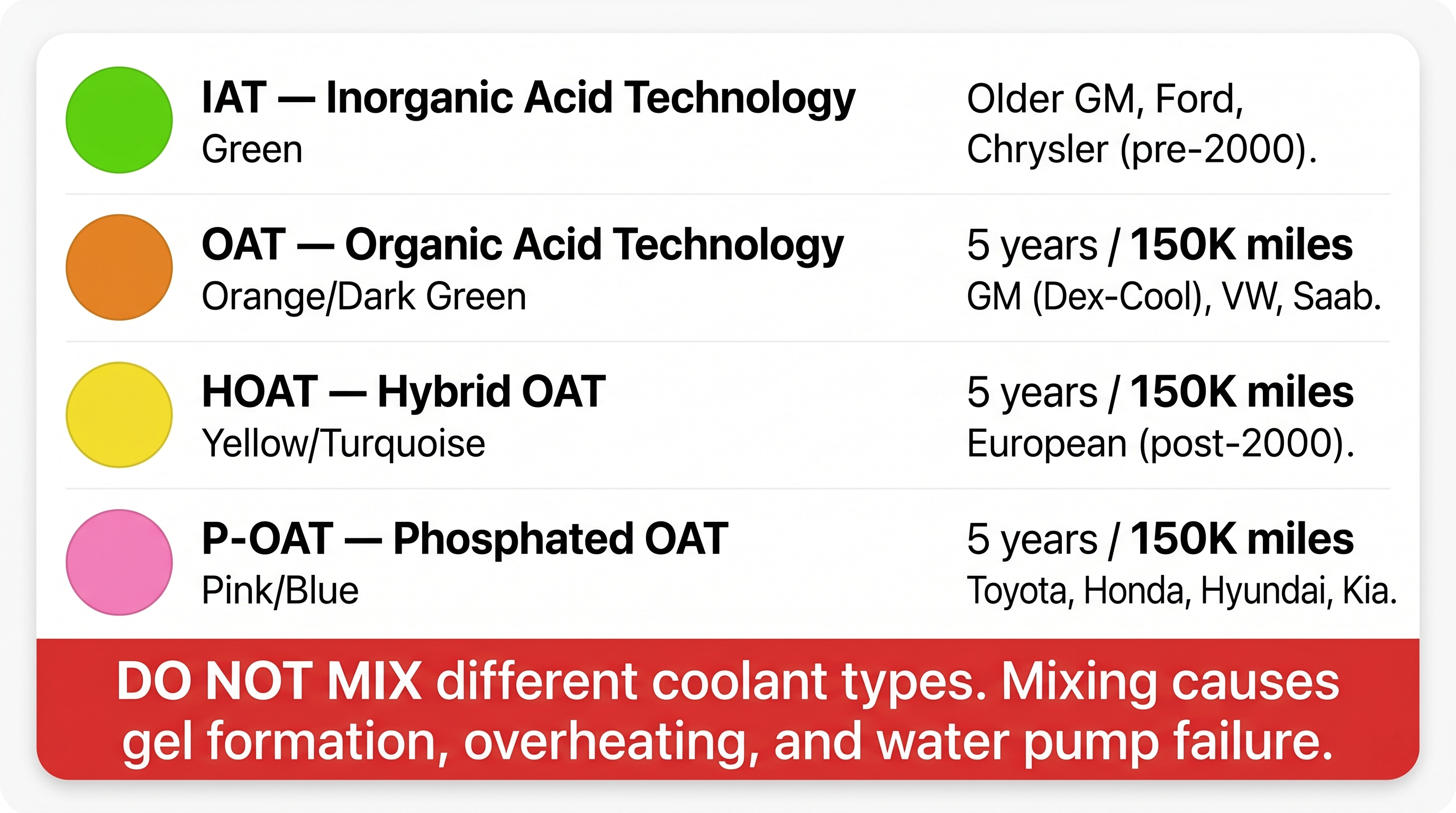
Three coolant chemistries cover nearly every vehicle on the road, and they are not interchangeable. The difference lies in their corrosion inhibitors — the additives that protect metal surfaces, gaskets, and water pump seals from the acidic byproducts of ethylene glycol breakdown.
| Type | Full Name | Inhibitors | Color(s) | Lifespan | Used By |
|---|---|---|---|---|---|
| IAT | Inorganic Acid Technology | Silicates, phosphates | Green | 2 yr / 30,000 mi | Pre-2000 domestic vehicles |
| OAT | Organic Acid Technology | Organic acids | Orange, pink, red | 5 yr / 150,000 mi | GM (Dex-Cool), VW, Saab |
| HOAT | Hybrid Organic Acid Technology | Organic acids + silicates | Yellow, turquoise, purple | 5 yr / 100,000 mi | Ford, Chrysler, European makes |
| P-OAT | Phosphated OAT | Organic acids + phosphates | Pink, blue | 10 yr / 100,000 mi | Toyota, Honda, Hyundai, Kia |
IAT coolant — the traditional green formula — uses fast-acting silicate inhibitors that coat metal surfaces but deplete within 2–3 years. OAT coolant replaced it starting in the late 1990s with organic acids that last 5+ years. GM's Dex-Cool (OAT) earned a bad reputation in the early 2000s when vehicles with air leaks in the cooling system developed intake manifold gasket failures — a problem caused by the air intrusion, not the coolant chemistry itself.
Mixing different coolant chemistries causes the corrosion inhibitors to react and precipitate, forming a gel-like sludge that blocks radiator passages, clogs the heater core, and reduces cooling efficiency. If you don't know what's in your system, do a full flush and refill with your manufacturer-specified type. The coolant specification is listed in your owner's manual and on the reservoir cap.
Coolant color is a clue, not a guarantee. Both Toyota (P-OAT) and BMW (HOAT) use blue-tinted coolant with completely different chemistry. Match by specification name — SLLC, Dex-Cool, Motorcraft Gold — not by color alone.
Prestone sells a "compatible with all makes and models" universal OAT coolant. After a full system flush, it works for out-of-warranty vehicles. But it doesn't meet every OEM specification, and using it on a vehicle still under warranty could void cooling system coverage. For warranty vehicles, use the manufacturer's product. The same rule applies when changing your transmission fluid — always match the OEM specification, not the cheapest option on the shelf.
Coolant Flush vs. Drain and Fill
A drain-and-fill opens the radiator's petcock valve, lets gravity pull the old coolant out, and refills with fresh fluid. It costs $80–$150 at a shop and replaces roughly 50–60% of your total coolant volume. The rest stays trapped in the engine block, heater core, and hoses.
A full machine flush forces new coolant through the entire system under pressure, displacing close to 100% of the old fluid. It costs $120–$200 and uses a pump that circulates new coolant while pushing old fluid out through the heater hoses.
For routine maintenance on a well-maintained vehicle, a drain-and-fill every interval is sufficient. Save the full machine flush for neglected systems, vehicles with unknown service history, or after coolant contamination like a head gasket leak mixing oil into the coolant. Two consecutive drain-and-fills with a distilled water rinse between them achieve roughly 85–90% fluid exchange without a machine.
If you're switching coolant types — from Dex-Cool to a different OAT, or from IAT to HOAT — a full flush is mandatory. A drain-and-fill leaves 40–50% of the old chemistry behind, enough to cause additive conflicts with the new fluid.
How to Check Your Coolant
Open the coolant reservoir cap (engine cold) and look at the fluid. Healthy coolant is translucent and matches its original color — pink, blue, orange, or green. Brown or rust-colored fluid, floating particles, or an oily film all signal replacement regardless of mileage.
Three tests give a more precise reading:
- Visual inspection. Look for oil contamination (milky, chocolate-milk appearance), rust flakes, or gel clumps. A milky appearance specifically suggests a head gasket or oil cooler leak — a more serious problem than old coolant.
- pH test strips. Coolant-specific test strips cost $5–$8 at any auto parts store. Healthy coolant reads pH 8.0–10.0. Below 7.0 means the corrosion inhibitors are depleted and the fluid has turned acidic enough to attack aluminum and copper components.
- Refractometer. A refractometer ($20–$30) measures freeze-point protection by shining light through a coolant sample. A proper 50/50 mix protects to at least −34°F (−37°C). The floating-ball hydrometers sold at auto parts stores work but are less accurate.
AutoZone, O'Reilly, and NAPA test coolant for free — bring in a small sample or drive in.
DIY Coolant Drain and Fill
A drain-and-fill is one of the simpler fluid maintenance jobs, similar in difficulty to an oil change. You need basic hand tools, a couple of hours, and the correct coolant for your vehicle.
Tools and materials:
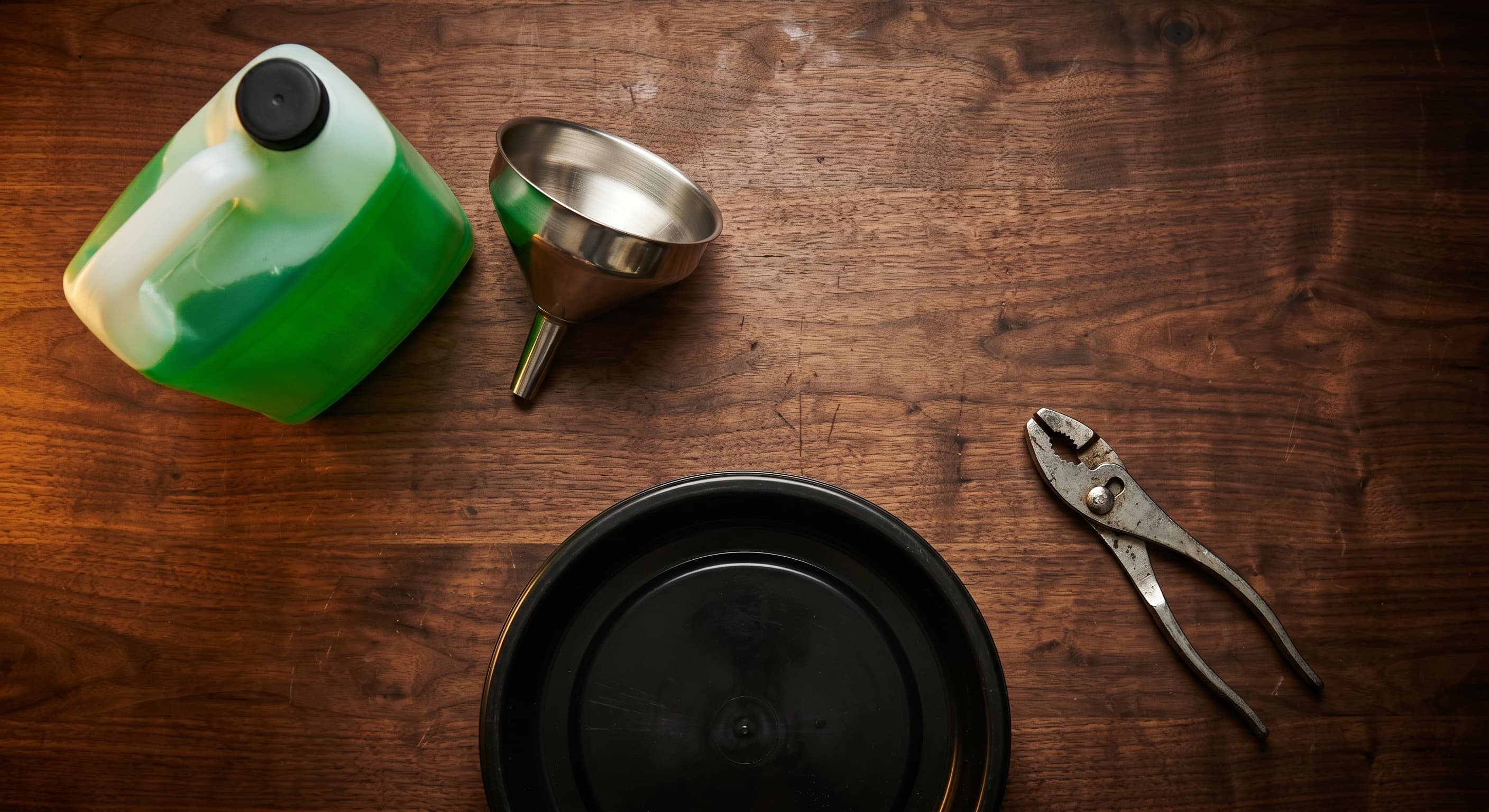
- Drain pan, 2+ gallon capacity
- Pliers or socket set for petcock access
- Funnel with radiator adapter (a no-spill funnel like the Lisle 24680 saves cleanup)
- 2 gallons of manufacturer-specified coolant (pre-mixed, or concentrate plus distilled water)
- 2–3 gallons of distilled water for flushing
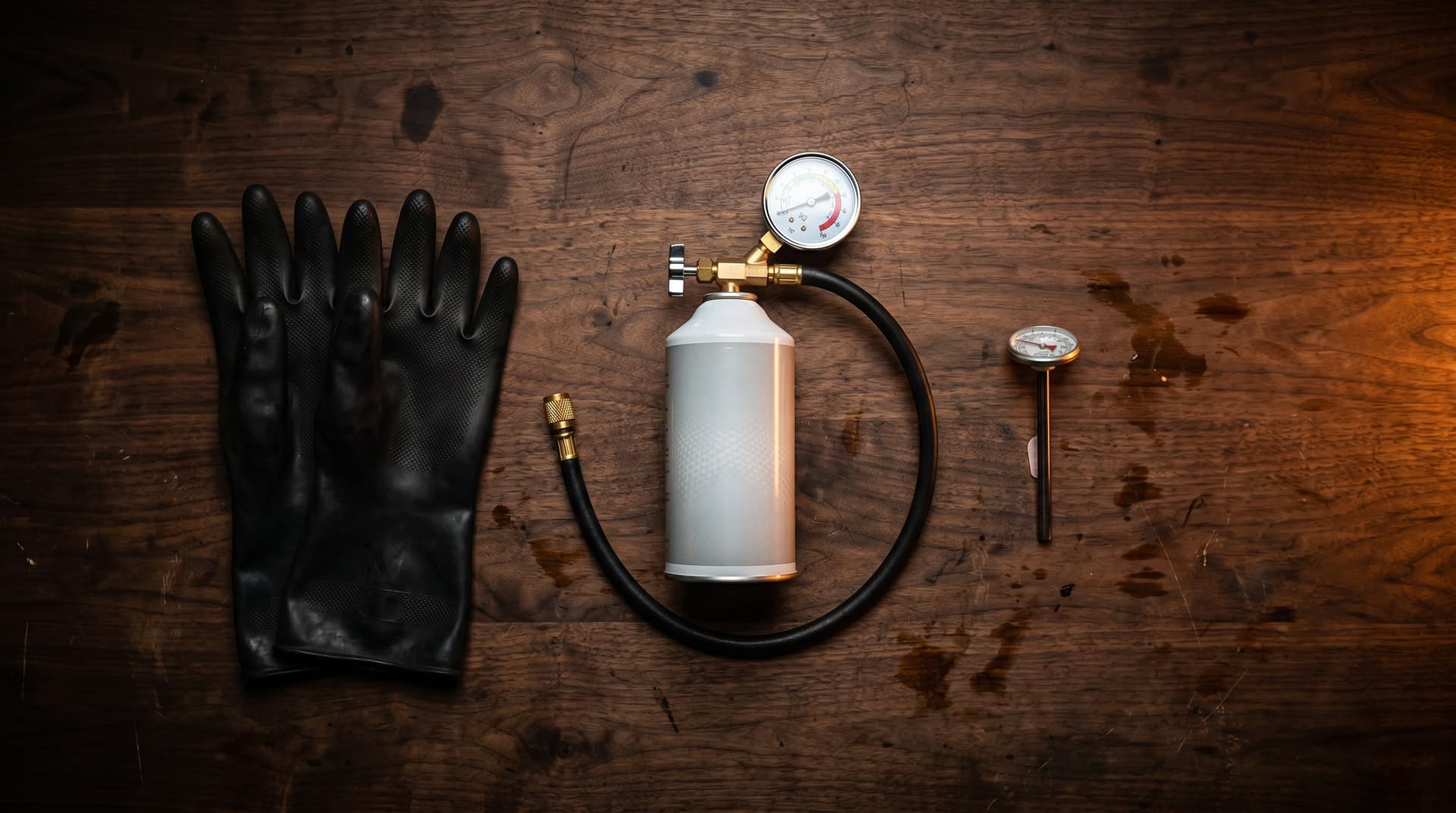
- Safety glasses and chemical-resistant gloves
Steps:
- Wait for the engine to cool completely. At least 2 hours after driving. A hot cooling system is pressurized to 13–16 psi. Opening the cap on a warm engine sprays boiling coolant.
- Position your drain pan under the radiator petcock. The petcock is at the bottom of the radiator, typically on the driver's side. It's a small plastic or brass valve — open it with pliers or a quarter-turn by hand.
- Drain the old coolant. Takes 5–10 minutes. You'll collect 4–6 quarts from the radiator on most 4-cylinder engines — roughly half the system's total 8–12 quart capacity.
- Flush with distilled water. Close the petcock, fill with distilled water, run the engine for 10 minutes with the heater set to max, let it cool fully, then drain again. Repeat until the water drains clear — usually 2–3 cycles.
- Refill with new coolant. Close the petcock. Fill slowly through the radiator neck or reservoir using your manufacturer-specified coolant. Use a 50/50 concentrate-to-distilled-water mix, or buy pre-mixed. Pour slowly — fast filling traps air pockets.
- Bleed the air. With the radiator cap off, idle the engine to operating temperature. The thermostat opens around 195°F, coolant level drops, and air bubbles escape. Top off as needed. Honda, Subaru, and many European vehicles have a dedicated bleed valve — your owner's manual shows its location.
- Verify the level after driving. After a 15-minute drive, let the engine cool and check the reservoir. Top off to the "Full Cold" line. Look under the car for drips around the petcock and hose connections.
Safety: Ethylene glycol coolant is toxic and has a sweet taste that attracts animals and children. Clean up spills immediately with absorbent material. Most auto parts stores accept used coolant for recycling at no charge — do not pour it down a drain or onto the ground.
After you finish the job, log the service in Pinion with your mileage and the coolant type you used so your next reminder is set to the correct interval.
Frequently Asked Questions
How much does a coolant flush cost?
A coolant flush costs $100–$200 at an independent shop, or $150–$300 at a dealership. DIY costs run $30–$60 for coolant and supplies. European vehicles (BMW, Mercedes, Audi) cost more because they require brand-specific coolant at $25–$40 per gallon compared to $10–$15 for domestic-spec coolant. RepairPal's 2026 data shows vehicle-specific variation: a Honda Civic coolant change averages $270–$316, while a Chevy Silverado 1500 runs $624–$692 due to its larger cooling system.
How often should you flush your coolant?
Most manufacturers recommend coolant replacement every 5 years or 100,000 miles for modern long-life coolants. Older vehicles using conventional green coolant (IAT) need it every 2 years or 30,000 miles. The interval varies by make: Toyota's pink SLLC is rated for 100,000 miles initially (then 50,000), Honda's blue Type 2 goes 120,000 miles before the first change (then 60,000), and BMW requires changes every 40,000 miles. Your owner's manual has the exact specification for your vehicle.
What is the difference between a coolant flush and drain and fill?
A drain-and-fill opens the radiator drain petcock, lets the old coolant flow out by gravity, and refills with new fluid — replacing about 50–60% of the total system volume. A full flush uses a machine to push new coolant through the entire system including the heater core and engine block, replacing nearly 100%. Drain-and-fill costs $80–$150 and works for routine maintenance. A machine flush costs $120–$200 and is better for neglected systems with discolored or contaminated coolant.
Can you mix different types of coolant?
No. Mixing different coolant chemistries (IAT green, OAT orange/pink, HOAT yellow/gold) causes the corrosion inhibitors to react, forming gel-like sludge that blocks radiator passages and reduces cooling efficiency. This can lead to overheating, water pump seal damage, and heater core failure. If you don't know what's in your system, do a full flush and refill with the manufacturer-specified type. The coolant type is printed in your owner's manual and usually on the coolant reservoir cap.
Frequently Asked Questions
Vlad Kuzin
Developer of Pinion. Writes about car maintenance to help people save money and stay safe on the road.